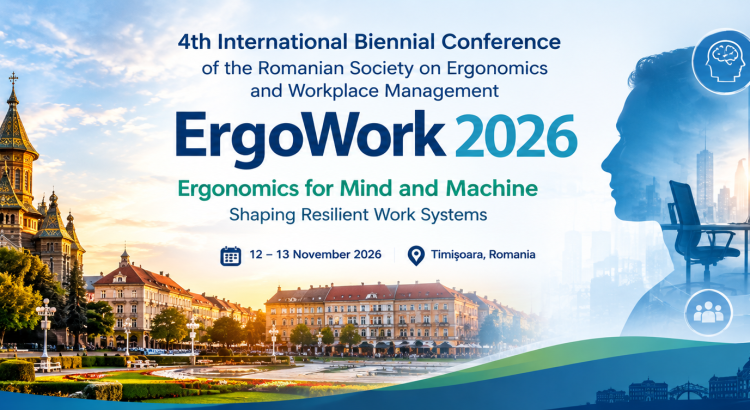
ErgoWork 2026

ErgoWork 2026 – Ergonomics for Mind and Machine

The 4th International Biennial Conference of the Romanian Society on Ergonomics and Workplace Management – ErgoWork 2026 will take place in Timișoara, Romania, on 12–13 November 2026.

Organised by the Romanian Society on Ergonomics and Workplace Management in collaboration with Politehnica University of Timișoara and partner organisations, the conference will bring together researchers, practitioners and professionals interested in ergonomics, human factors, occupational health and safety, workplace management and the future of work. The Romanian Society is a member of FEES and the International Ergonomics Association.

The theme of ErgoWork 2026 is “Ergonomics for Mind and Machine – Shaping Resilient Work Systems.” The conference addresses the interaction between people, technology and organisations, including developments associated with AI and Industry 5.0, and their implications for sustainable, healthy, inclusive and human-centred workplaces.

The scientific programme covers topics including ergonomics and workplace design, smart systems and biomechanics, occupational health and safety, sustainability and wellbeing, cognitive ergonomics, and future learning and work environments. The event provides an opportunity to present research and practical experience, exchange ideas and strengthen cooperation within the European ergonomics community.

Activities on 12 November include professional discussions and networking, followed by the main conference programme on 13 November at the Conference Centre of Politehnica University of Timișoara, with invited presentations, scientific sessions and opportunities for professional exchange.

Date: 12–13 November 2026
Location: Timișoara, Romania
Paper submission deadline: 1 November 2026

ErgoWork 2026 – official conference website

European Month of Ergonomics 2010 – Ergonomics is a Key to Safe Maintenance

Ergonomics is a key to safe maintenance! 

Ergonomics makes maintenance lighter, more fluent and more acceptable – and safer Proper ergonomics design takes account of the life-cycle of systems: besides their daily operation, also assembly, maintenance, cleaning, reparation, renovation and dismantling By following the ergonomics design principles, guidelines and procedures, given in European ergonomics standards (EN), maintenance conditions and activities can be optimized to the worker/operator
See the following examples of ergonomics considerations in maintenance activity – presented in order of their nature, physical, cognitive or organizational 
Physical problems in maintenance work: 

  1. working in unfavorable locations (e.g. in high places, in narrow spaces) 
  2. working in awkward postures 
  3. insufficient space for the hand movements or seeing, lack of free maintenance space 
  4. excessive force required for operations e.g. in changing of components, in opening valves 
  5. excessive physical workload in some tasks e.g. changing pumps without hoisting equipment 
  6. poor lighting and thermal conditions, high noise and vibrations levels 
  7. hazards, e.g. mechanical, electric, chemical 

Cognitive (or mental) problems of maintenance work: 

  1. visually poor displays and symbols, text not legible in varying environment 
  2. use of maintenance equipment not intuitive 
  3. maintenance procedures not logical, memorable or controllable 
  4. instructions not easy-to-understand 
  5. disturbance situations poorly instructed or guided 
  6. other activities around, attention directed elsewhere 

Organizational problems of maintenance: 

  1. inappropriate division of tasks between the operator and the machine – e.g. lack of equipment for lightening heavy tasks 
  2. inappropriate division of tasks between operators – unbalanced workload inappropriate working hours (shifts, extensive work periods) – reduced physical and mental performance
  3. poor communication between operators 
  4. poor guidance of the operators 

With the help of ergonomics knowledge and ergonomics approach, the maintenance conditions and activities inherently become good for the operator and good for the organization: 

  1. better satisfaction, motivation and commitment of the operator 
  2. lower rate of accidents and fewer sick leaves 
  3. less disturbances and losses due to human error 
  4. better quality, less careless work 
  5. fluent and cost-effective maintenance, right operations in the correct way, in a minimum time, with minimum effort
  6. by proper ergonomics design, less need for corrections later, and fewer costs of late changes.

The presentation’s purpose is to clarify ergonomics and demonstrate how it is essential in improving maintenance conditions. FEES recommends that the EME 2010 relate to the Healthy Workplace campaign “Safe maintenance,” promoted by the EU-OSHA, European Agency for Safety and Health at Work.