Developing professional competencies and learning from experience

SAFERA SAF€RA is a partnership between 19 research funding organizations from 10 European countries who collaborate on research programming and launch joint calls in the field of industrial safety. It prolongs the work developed in the SAF€RA ERA-NET, which was funded by the European Union’s Seventh Framework Programme for research, technological development and demonstration.

SAFERA SAF€RA is a partnership between 19 research funding organizations from 10 European countries who collaborate on research programming and launch joint calls in the field of industrial safety. It prolongs the work developed in the SAF€RA ERA-NET, which was funded by the European Union’s Seventh Framework Programme for research, technological development and demonstration.

The 3rd SAFERA call contains human factors related research questions e.g.

  • What is the relative effectiveness of the methods for developing
    professional competencies and skills, in particular concerning their safety impact? What
    relevant metrics can be proposed?
  • What key factors can improve the effectiveness of these methods for developing
    professional knowledge and competencies?
  • Which new mechanisms and procedures for learning in industrial safety, including serious
    games, simulator-based techniques, e-learning platforms, debriefings, storytelling and
    “enriched learning from experience” can be proposed? What are the strengths and
    weaknesses of different approaches in developing knowledge, skills and competencies?
  • Do managers appreciate the importance of debate within a work group or community of
    practice for the development of knowledge and skills, and hence for safety? How can this
    bottom-up “invisible work” be made more visible and better integrated with the top-down
    dimensions of safety management?
  • Can new types of training, based on discussion concerning situated work activities, the
    risks of specific tasks and the possible conflicts between safety procedures and work
    situations, be proposed and tested?
  • Is there potential to learn more from success (and not only from failures) and to share this
    learning within work groups and communities of practice?

The following types of research are expected:

  • case studies which analyze existing practices and highlight their key features and obstacles to
    their application elsewhere;
  • development and evaluation of new approaches to develop professional skills and
    competencies;
  • exploratory studies (appreciative inquiries).

For details please visit http://call.safera.eu/2016/).
Latvian Ergonomics Society has been admitted to CREE

CREE
The 48th meeting of CREE was held in Riga, Latvia November 2015.

After the meeting there is 468 registered ergonomists from 22 countries.
A new national assessment board has been established in Latvia: the president is Henrijs Kalkis, assessors are Zenija Roja, Ricards Balnass, secretary Liene Stoka.

CREE
The 48th meeting of CREE was held in Riga, Latvia November 2015.

After the meeting there is 468 registered ergonomists from 22 countries.
A new national assessment board has been established in Latvia: the president is Henrijs Kalkis, assessors are Zenija Roja, Ricards Balnass, secretary Liene Stoka.

Interested people should contact their local CREE representative ( see www.eurerg.eu) for further details.

Factors leading to musculoskeletal disorders are reported very frequently across all activity sectors

According to ESENER-2, the 2nd most frequent risk factor is tiring or painful positions, including sitting for long periods, and the third is repetitive hand or arm movements.

According to ESENER-2, the 2nd most frequent risk factor is tiring or painful positions, including sitting for long periods, and the third is repetitive hand or arm movements.

The European Agency for Safety and Health at Work (EU-OSHA) launched the main findings of the Second European Survey of Enterprises on New and Emerging Risks (ESENER-2) at the European Parliament in Brussels. The results of the survey — which collected responses from almost 50,000 workplaces in 36 countries, including all 28 Member States — give a detailed insight into how occupational safety and health (OSH) risks are managed in Europe’s workplaces.

The most commonly reported risk factor is having to deal with difficult customers, patients, pupils and so on (58% of establishments in the EU-28), which in part reflects the continued growth of the service sector.

The rate of establishment where tiring or painful positions, including
sitting for long periods
are present, regardless of whether it is currently
under control and regardless of the number of employees it affects on the chart above.
To discover the survey go to https://osha.europa.eu

University courses on Ergonomics and Human Factors

To browse MSc in Europe, please go to Ergonomics education, training and courses.

A supplementary non-comprehensive list of university courses on Ergonomics and Human Factors:

PhD in Europe

To browse MSc in Europe, please go to Ergonomics education, training and courses.

A supplementary non-comprehensive list of university courses on Ergonomics and Human Factors:

PhD in Europe

PhD in other continents:

MSc in other continents:

If your course is not inculded please send a mail to info@ergonomics-fees.eu

Ergonomics in OSHwiki, the new EU-OSHA knowledgebase

OSHwiki is a reliable source of ergonomics and more OSH information. Contributors include many national organisations for occupational safety and health as well as leading research institutes and accredited authors can create and edit content quickly and easily.

OSHwiki logo

OSHwiki is a reliable source of ergonomics and more OSH information. Contributors include many national organisations for occupational safety and health as well as leading research institutes and accredited authors can create and edit content quickly and easily.

OSHwiki logo

With nearly 300 articles already uploaded by OSH experts, topics found on the platform cover areas such as OSH management and organisation, dangerous substances, psychosocial issues and groups at risk. As a one-stop shop for OSH content, OSHwiki aims to be the go-to resource on health and safety for the OSH community and beyond.

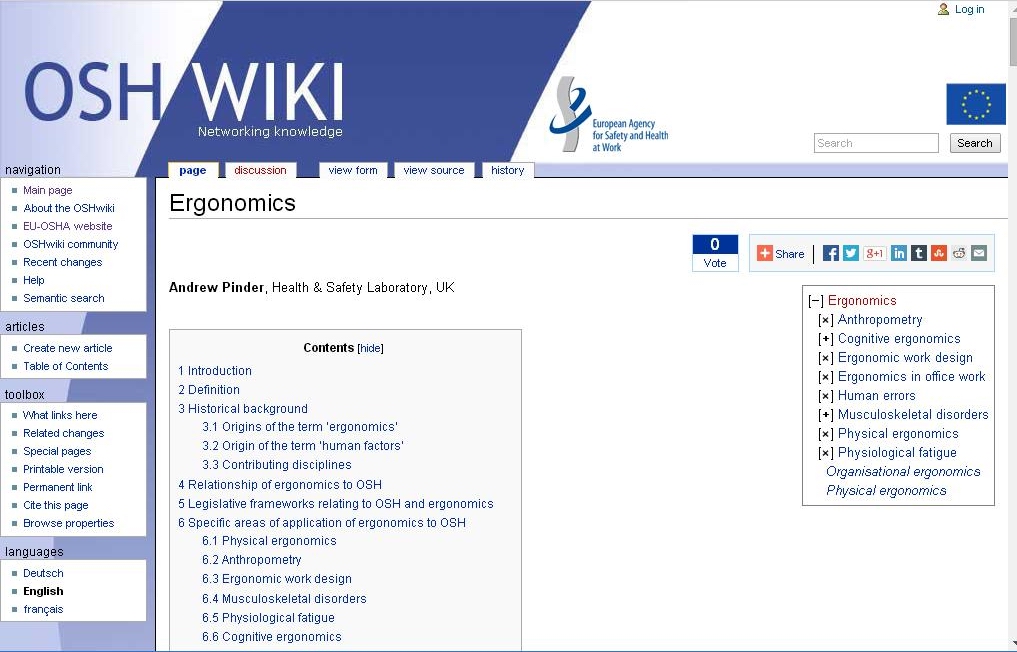
OSHwiki screenshot

There are several pages dedicated to ergonomics, covering physical, cognitive, and organisational ergonomics, the category Musculoskeletal disorders contains 14 pages from “Assessment of physical workloads to prevent work-related MSDs” to “Work-related musculoskeletal disorders among hospital workers

New video on Stress

The Federation of European Ergonomics Societies supports the new two year Europe-wide campaign: ‘Healthy Workplaces Manage Stress’ of the European Agency for Safety and Health at Work (EU-OSHA).

On behalf of FEES Gyula Szabó attended the Campaign Partnership Meeting in Brussels 8 April 2014, where a detailed campaign introduction and the Campaign Video World Premier took place.On behalf of FEES Gyula Szabó attended the Campaign Partnership Meeting in Brussels 8 April 2014, where a detailed campaign introduction and the Campaign Video World Premier took place.


Societal Stakeholders’ Toolbox at CEN and CENELEC

CEN and CENELEC have launched a new section on their website as part of their ongoing efforts to encourage the widest possible range of stakeholders to get involved in standardization activities and help shape the content of European Standards. 


The ‘Societal Stakeholders’ Toolbox’ is aimed in particular at supporting the participation of organizations that are concerned with defending the interests of consumers, protecting the environment, and promoting the health and safety of workers.

Standards, which are documents that set out specifications and other technical information with regard to various kinds of products, materials, services and processes, can have significant impacts on the safety and well-being of consumers and workers, as well as on the wider society and the environment. Enabling organizations representing societal stakeholders to participate in the development of standards helps to ensure that all relevant concerns can be taken into account during the drafting process.

The ‘Societal Stakeholders’ Toolbox’ can be accessed directly from the homepage of the CEN-CENELEC website. It provides practical advice to organizations representing consumers, workers and environmental interests on where to find information about ongoing standardization activities and how they can contribute to the standards development process at national, European and international levels.

The toolbox has been developed by CEN and CENELEC in the framework of their ongoing collaboration with three umbrella organizations that represent the interests of specific interest groups within the European Standardization System.  These organizations are: ANEC (the European consumer voice in standardisation), ECOS (European Environmental Citizens Organisation for Standardisation), and ETUI(European Trade Union Institute – Health and Safety Department).

At national level, many members of CEN and CENELEC are also cooperating with societal stakeholders organizations. Based on existing examples of good practice, CEN and CENELEC are encouraging all of their members (in 33 European countries) to support the active involvement of societal stakeholders in standardization activities and to facilitate this by providing relevant information on their respective websites.

The ‘Societal Stakeholders’ Toolbox’ was officially presented at the CEN-CENELEC New Year Cocktail Reception, which took place in Brussels on 22 January 2014.

NAPO Study resources for teachers

Using the ever-popular Napo character, EU-OSHA, the European Agency for Safety and Health at Work, together with the Napo Consortium has devised a series of occupational safety and health (OSH) education toolkits for teachers, aimed at introducing health and safety topics to primary school children in an educational, yet fun and imaginative way using the Napo clips and creative activities.

Using the ever-popular Napo character, EU-OSHA, the European Agency for Safety and Health at Work, together with the Napo Consortium has devised a series of occupational safety and health (OSH) education toolkits for teachers, aimed at introducing health and safety topics to primary school children in an educational, yet fun and imaginative way using the Napo clips and creative activities.

Each study pack outlines the key messages and learning objectives, offering teachers full details on suggested activity ideas and the resources required, alongside a sample lesson plan that can be readily incorporated into a typical 40 minute lesson.

The resource packs offer suggested lesson plans to educate children aged between seven and eleven on the importance of health and safety. The informative education toolkits feature full instructions, suggested activities and accompanying downloadable resources, to provide teachers and educators support and guidance on incorporating OSH messages into the existing curriculum. The flexible lessons are designed to fit alongside current curriculum subjects to reinforce and assist in their teaching. These include:

  • Personal Health and Social Education (PHSE)
  • Science
  • Road Safety
  • Language learning
  • Arts

Report sheds light on the key factors determining OSH practice

A new report from EU-OSHA describes the contextual and environmental factors that shape approaches to OSH management

A follow-up study to ESENER, the report finds that working environments in EU Member States have a dynamic and changing nature. However, the differences between them are significant. This insight helps to explain why EU work requirements are not applied in the workplace in a universal manner.

A new report from EU-OSHA describes the contextual and environmental factors that shape approaches to OSH management

A follow-up study to ESENER, the report finds that working environments in EU Member States have a dynamic and changing nature. However, the differences between them are significant. This insight helps to explain why EU work requirements are not applied in the workplace in a universal manner.