56th CREE Meeting in Zagreb, Croatia

CREE

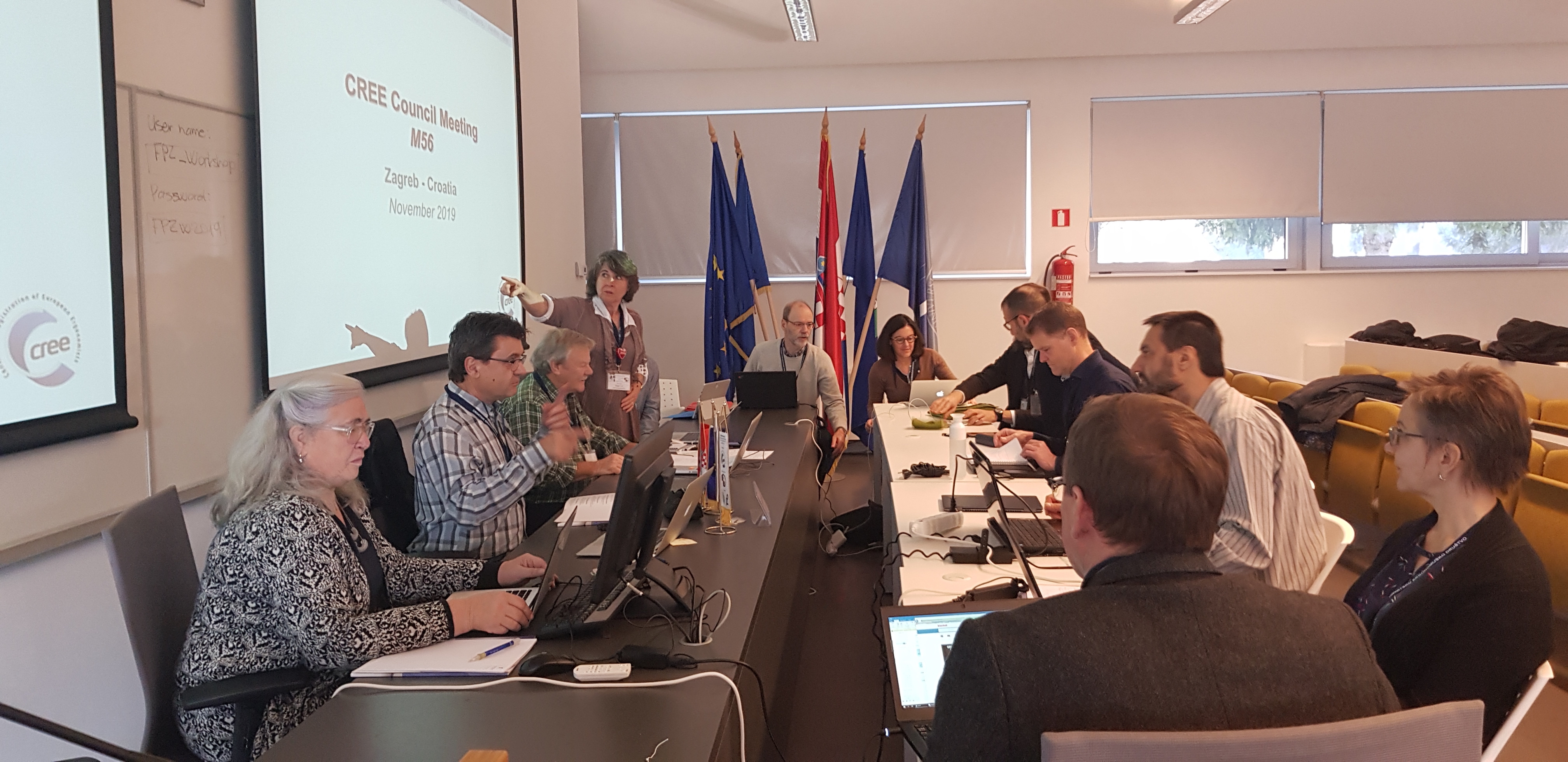
We are proud to announce that the 56th Council Meeting of the Centre of Registration of European Ergonomist in November 2019 accepted 24 new certified ergonomists. Moreover, 31 people successfully renewed their certification.

Among the prolongations was professor Leszek Pacholski, and we have several new professional working at MTO Safety AB. Stockholm, Sweden. 

CREE

We are proud to announce that the 56th Council Meeting of the Centre of Registration of European Ergonomist in November 2019 accepted 24 new certified ergonomists. Moreover, 31 people successfully renewed their certification.

Among the prolongations was professor Leszek Pacholski, and we have several new professional working at MTO Safety AB. Stockholm, Sweden. 

“New European regulatory requirements in several domains will focus on human factors, HTO and ergonomics. MTO Safety has certified our consultants to meet the new requirements. Certification is a part of our quality assurance process” motivates Lena Kecklund, CEO at MTO Safety in Stockholm, why they certify so many to become EurErg.

The meeting was held at the University Campus Borongaj, organised by Davor Sumpor and hosted by The Croatian Ergonomics Society which decided to establish the certification system in Croatia by 2024.

CREE 55th meeting

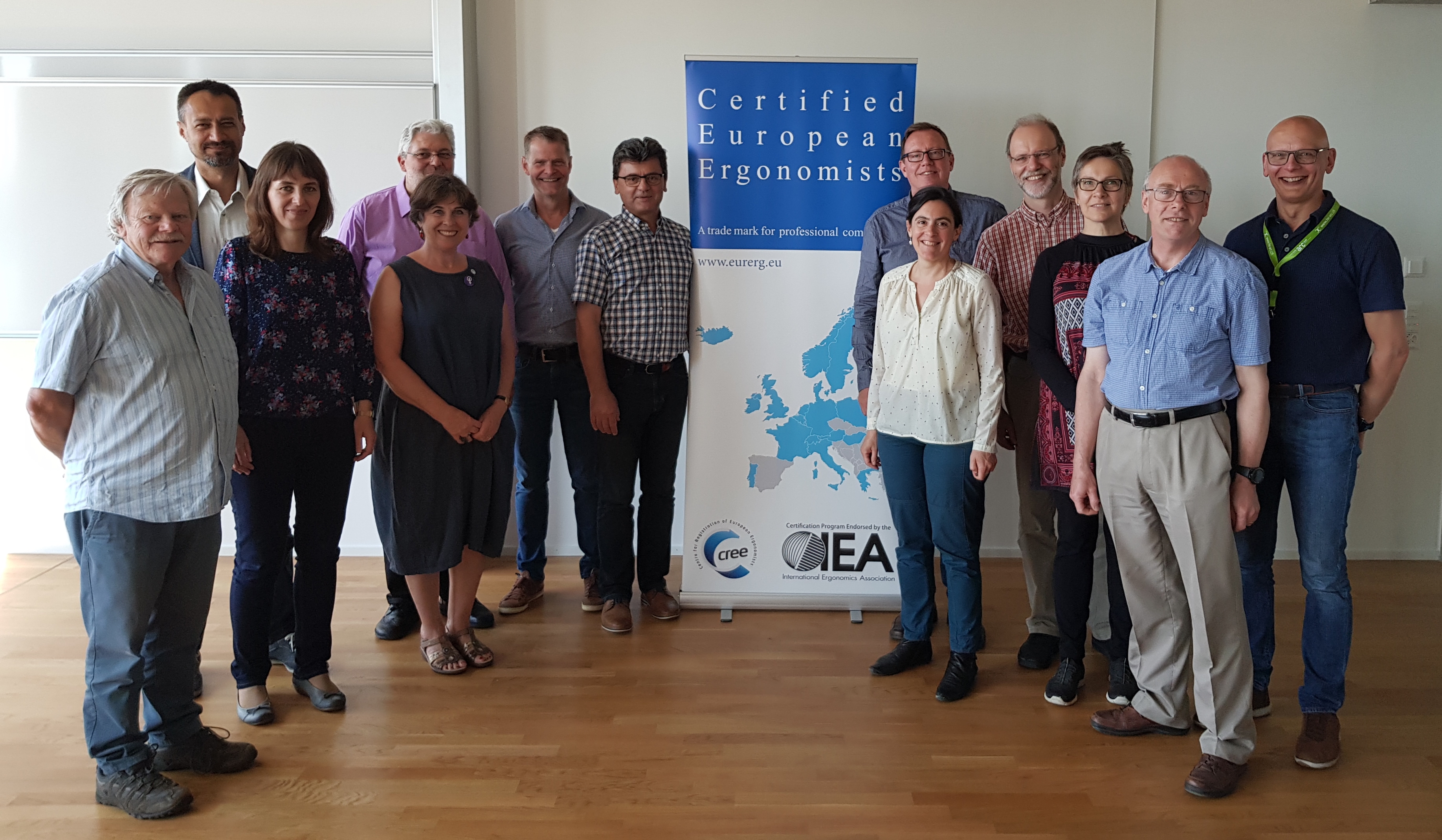
From left to right: Maria Niessen (Treasurer), Bernard Dugué (President), David O’Neill (Secretary-General), Maggie Graf (Development Officer), Karsten Kluth, Nathalie Chiosi, Frank Krause, Gyula Szabó, Anders Sundin and Beata Mrugalska (Communication Officer – a photographer)

Full list of registered European ergonomist is available at the CREE directory.

Applied Ergonomics Conference 2020

ACE 2019

The
Applied Ergonomics Conference scheduled for March 16 – 19, 2020 at the Kentucky International Convention Center in Louisville, Kentucky, USA has been postponed due to the COVID-19 situation. The conference website is www.appliedergoconference.org.

ACE 2019

The
Applied Ergonomics Conference scheduled for March 16 – 19, 2020 at the Kentucky International Convention Center in Louisville, Kentucky, USA has been postponed due to the COVID-19 situation. The conference website is www.appliedergoconference.org.

The conference committee and IISE closely monitored the
situation and determined that the Conference would be reformatted as a virtual
event on Aug. 4-6, 2020. For information about the virtual event program, please
visit this page: https://www.iise.org/AEC/details.aspx?id=7016

For additional information, please contact the AEC 2020 International Outreach Committee Chair, Marise Carroll (marise.o.carroll@gmail.com).

Endorsed by FEES

55th CREE Meeting in Delémont, Switzerland

CREE

The Centre of Registration of European Ergonomist (CREE) Council announces that 17 new certified ergonomists were accepted and 14 people successfully renewed their certification at the 55th Council Meeting Delémont, Switzerland, 7-8 June 2019.

CREE

The Centre of Registration of European Ergonomist (CREE) Council announces that 17 new certified ergonomists were accepted and 14 people successfully renewed their certification at the 55th Council Meeting Delémont, Switzerland, 7-8 June 2019.

During the meeting the members of the CREE Board and Council participated in a workshop on “Ergonomics 4.0 and Ethics“ co-organized by ErSys Sàrl, the Swiss Society for Ergonomics (SwissErgo) and the University of Applied Sciences Western Switzerland (Haute Ecole Arc Santé).

CREE 55th meeting

From left to right: David O’Neill, Gyula Szabó, Beata Mrugalska, Maggie Graf, Christian Voirol, Frank Krause, Bernard Dugué, Nathalie Chiosi, Anders Sundin, Karsten Kluth, Pirjo Hakkarainen, Mike Gray, Gaetan Dusollier

Full list of registered European ergonomist is available at the CREE directory.

Council Meeting 2019

FFES Logo The 2019 council meeting of the Federation of the European Ergonomics Societies (FEES) will be held The 2019 council meeting of the Federation of the European Ergonomics Societies (FEES) will be held 25th
of August 2019, in Elsinore, Denmark, 
in conjonction with the IEA Council Meeting and the 50th Anniversary Conference of the Nordic Ergonomics and Human Factors Society (NES) “50th Future Work: Digitalisation and Innovation”.

DRAFT TIMETABLE of the meeting

Welcome at 8 : 30, start at 9 : 30, end at 4 : 00 pm

See attachment FEES-council-draft-agenda-V1-August2019.pdf

Practical information

  • The Council meeting will take place in the NES2019 Congress location.

Registration form

54th CREE Meeting in Athens, Greece

CREE

The 54th Council Meeting of the Centre of Registration of European Ergonomist (CREE) was held in Athens, Greece, 30 November – 1 December 2018. 12 new certified ergonomists were accepted, and 32 people successfully renewed their certification.

CREE

The 54th Council Meeting of the Centre of Registration of European Ergonomist (CREE) was held in Athens, Greece, 30 November – 1 December 2018. 12 new certified ergonomists were accepted, and 32 people successfully renewed their certification.

Full list of the 424 registered European ergonomist is available at the CREE directory.

Building Health and Social Care Systems for the Future: Demographic Changes, Digital Age and Human Factors

APERGOHEPS 2019 will take place in Lisbon, Portugal, from 3rd – 5th, July 2019, at Hotel Marriot and the topic of this 6th edition of HEPS is “Building Health and Social Care Systems for the Future: Demographic Changes, Digital Age and Human Factors”.

APERGOHEPS 2019 will take place in Lisbon, Portugal, from 3rd – 5th, July 2019, at Hotel Marriot and the topic of this 6th edition of HEPS is “Building Health and Social Care Systems for the Future: Demographic Changes, Digital Age and Human Factors”.

Paper proposal submission deadline was extended until 4th of February (https://www.heps2019.com/index.php/call-for-papers).

HEPS Topics

  • Healthcare Ergonomics and Human Factors;
  • Ergonomics and Human Factors in Healthcare Quality;
  • Ergonomics and Human Factors in Primary Care;
  • Occupational Health and Safety;
  • E-ergonomics and e-occupational health services;
  • Patient Safety;
  • Infection Control;
  • Errors in Healthcare and Patient Safety;
  • Healthcare Systems Design;
  • Social Systems Design;
  • Organizational Design of healthcare systems;
  • Resilience in Healthcare Systems;
  • Technologies and Healthcare Systems;
  • Patients Experiences / Patients Participation / Involvement;
  • Demographic challenges and patient safety;
  • Innovation in healthcare.

Authors are invited to submit manuscripts in electronic format using our conference paper submission system.

HEPS 2019

Peer-review accepted papers will be published as chapters in Springer Edited Books. Each chapter will have DOI and the proceedings book will be indexed at Ei Compendex, ISI, DBLP, SCOPUS, Google Scholar and Springerlink.

A selection of accepted and registered authors will be invited to submit an extended version of their paper to be published by WORK.

More information can be found on the conference website: http://heps2019.com

Endorsed by FEES

How to contribute to another world? – SELF 2019 Congress

SELF2019

How to contribute to another world?

September 25-27, 2019, Paris.

The project of the 54th SELF Congress is part of a dynamic that should allow the construction of a program combining originality and diversity. 

SELF2019

How to contribute to another world?

September 25-27, 2019, Paris.

The project of the 54th SELF Congress is part of a dynamic that should allow the construction of a program combining originality and diversity. 

Beyond the communications, projects of debate and production around the questions relating to all the themes of the Congress and the SELF are expected. We are therefore listening to you to study, together, innovative or other modalities (a project of a round table, workshop, industrial visit, public meeting, animation …) giving way to your creativity and allowing together to advance on our questions and our problems. 

The project for a communication, event,… may be sent until the 30th of January 2019

SELF 2019

Main topics:

  • Work and employment
  • Economy (s) and Performance
  • Man and his tools
  • The question of activity
  • Health and Occupational Risks
  • Training and research in ergonomics
  • Professional structuring

Endorsed by FEES

Train for Human Centred Work

The TRAIN4WORK is a new initiative of the Federation of European Ergonomics Societies under the umbrella of Erasmus+, to create a freely accessible online ergonomics training material.

Scope and objectives

Human centered workplaces are a key essential part of the factories of the future due to important advantages:

  • Increase flexibility
  • Increase agility
  • Increase competitiveness
  • Reduce occupational and work-related diseases
  • Reduce absenteeism
  • Reduce sick level caused by injuries

Key actions required

  • Automated and continuous adaptation of work environment to workers
  • Integrate Health and Safety at work issues with production issues
  • Train professionals in the design of workplaces, processes and machinery

The main objective of TRAIN4WORK:

  • Development and implementation of a new online course (in English, Spanish, German and French)
  • To strengthen the knowledge and skills of targeted professionals in the design of human-centred workplaces.

The target groups of TRAIN4WORK

  • Engineers responsible for workplaces, process and production design
  • Engineers responsible for machinery, working equipment and tools design
  • Health and safety managers
  • Consultants who provide services related to these issues to industry
  • Human resources professionals (recruitment and job assignment of workers).

Project partners

Instituto de Biomecánica de ValenciaIBV Instituto de Biomecánica de Valencia (Coordinator)

The Instituto de Biomecanica (IBV) is a technological centre that studies the behavior of the human body and its interaction with products, environments and services. Founded in 1976, the Institute is currently coordinated under the agreement of the Valencian Institute of Business Competitiveness (IVACE) and the Universitat Politecnica de Valencia (UPV).
Contact: Elisa Signes Pérez, elisa.signes@ibv.org

Technische Universitat (TU) DarmstadtIAD (TUD) | Technische Universität Darmstadt – Institut fur Arbeitswissenschaft

The Technische Universitat (TU) Darmstadt is one of Germany’s leading technical universities. Its around 303 professors, 4,250 employees and 25,100 students devote their talents and best efforts to the significant future research fields energy, mobility, communications and information technologies, housing and living conditions. The wide variety of disciplines represented are all focused on technology, as viewed from the vantage point of engineering, the natural sciences, the humanities, and the social sciences, and cover the full range of academic endeavor, from the origination of basic concepts to practical, everyday applications.
Contact: Jurij Wakula, wakula@iad.tu-darmstadt.de

UGA | Universite Grenoble AlpesUniversite Grenoble Alpes

The Universite Grenoble Alpes (UGA) is a comprehensive university offering high-quality education in all academic disciplines and at all levels (undergraduate, master, doctorate, as well as certificate programs) to 45,000 students in initial and lifelong learning. Its dense territorial grid embraces the towns of Grenoble, Valence, Vienne, as well as several units located over the Isere territory. It belongs to the Communaute Universite Grenoble Alpes (COMUE) and works together with other HEIs on and outside of the campus, mutualizing some of their actions to improve the quality of their services.
Contact: Nicolas Villerme, nicolas.vuillerme@univ-grenoble-alpes.fr

Structo Ingenieros Consultores S.L.Structo Ingenieros Consultores

Structo is a dynamic company with a high adaptation to customer needs, because we have a multidisciplinary team of engineering. We have experience in conducting projects and Facilties. We develop projects in all sectors of industry and institutions. Project Management and Construction of industries of all sectors and facilities. We also carry out projects as industrial machinery, technical projects operating licenses, legalization of all kinds of industries and fire safety projects in industrial establishments.
Contact: Hugo Merelo, hugo.merelo@structoingenieros.com

FFES LogoFor more information contact Pedro Ferreira, treasurer of FEES: treasurer@ergonomics-fees.eu.


Project Planning

  • Project management & Quality management: To assure an adequate deployment of the project activities and the achievement of objectives set within the timescale and resources planned
  • Definition of curriculum: Identification of training requirements, definition of learning objectives and course structure
  • Development of training contents in English: To develop the contents based on the curriculum and the learning methodology defined in WP2
  • Development of e-learning course contents in English: Transform all the materials developed in the WP3 into a fully functional e-learning course, ready to be used in the pilot tests
  • Validation of the course and lessons learnt: Validation of the course adequacy to the skills/requirements of targeted end-users and usability assessment of the online platform
  • Development and Implementation of the final version of the e-learning course: Based on Deliverable 5.1 (Report on the course validation and lessons learnt), IBV will develop a final version of the e-learning course, implementing changes proposed in the validation. The course will be translated into Spanish (IBV), German (IAD) and French (UGA)
  • Dissemination and exploitation activities: Planning and management of dissemination activities and exploitation of project output

Multiplier event

  • E1. Workshop on design of human-centred work. (18-02-2020) (IAD)
  • E2. Workshop on Train4HCWork e-learning course. (10-03-2021) (IBV)

Intellectual Outputs

  • IO1. Course curriculum (M1-M6): It will include the learning objectives, the structure of the selected contents, the type of reinforcement activities, the ongoing monitoring schedule, the methodology for a continuous assessment, and potential accreditation procedures. It will be available in two different formats, text file and project website, and will be developed in English.
  • IO2. Online course in English (M7-M21): This output will consist of the first version online of the Train4HCWork course developed according to the curriculum (IO1). This course will include in an open e-learning platform the contents previously developed and reinforcement activities. This first prototype will be developed in English and will be ready to be tested in pilot validations.
  • IO3. Online course in French, German and Spanish (M17-M29): There will be four main actions to deploy the final course: validation of the first version of the e-learning course (IO2) (pilot course), development of the final version of the e-learning course, translation (to Spanish, German and French) and implementation in the platform.

Project results

  • AR1. Training requirements: Partners will develop a report summarizing the results of the studies performed to detect the vocational training requirements (knowledge, skills and competences) across Europe. This report will be provided in electronic format and disseminated at the website of the project in the Multiplier Event 1 and at partners’ websites. It will be the basis for the definition of a suitable and precise curriculum of the course (intellectual output IO1). In order to get these training requirements, three focus groups (FG) in three different countries and one on-line survey will be carried out.
  • AR2. Training contents: It will include the final version of the training contents. Training contents will cover the most important issues for a human-centred design, integrating knowledge in ergonomics, health and safety at work, and productivity.
  • AR3. Validation of the e-learning course: There will be a pilot course leaded by FEES (focused on professionals of ergonomics), UGA (focused on engineering students and professionals) and Structo (focused on specific demands of companies). IBV and IAD will monitor progress of participants and analyse the results of this monitoring. Finally, a report with recommendations to improve the training course (contents, reinforcement activities, schedule, platform, evaluation activities, etc.) will be proposed.
  • AR4. Dissemination activities: Besides the multiplier events, additional dissemination activities will be carried out. These activities will include, among others, presentations on key events of the target groups, dissemination through social networks, posters in conferences and symposia, or dissemination in the websites of project

Dissemination plan for project results at European level during and after the duration of project

(Deliverable D7.1: Dissemination and Exploitation plans)

  • Report on training requirements (AR1):
    • Dissemination of report amongst FEES members and collection of feedback
    • Produce input to Multiplier Event 1

    Development and deployment of on-line survey:

    • Development of survey structure, based on input from focus groups
    • Testing of survey
    • Deployment to FEES members, aiming to reach a minimum of 100 respondents
    • Provide feedback to respondents
  • Release of pilot course:
    • Dissemination of project milestone
    • Engagement of volunteers for the piloting
  • Multiplier event 1 (Workshop on design of human-centred work):
    • Announcement and promotion of workshop
    • Dissemination of workshop achievements and outputs
  • Multiplier event 2 (Workshop on Train4HCWork e-learning course):
    • Announcement and promotion of workshop
    • Dissemination of workshop and project achievements and outputs
  • Scientific dissemination
    • Validation of project methodology and approach
    • Project achievements

Project Administration

Grant Agreement obligations

  • The consortium should pay attention to the importance of dissemination and exploitation of the results and to the visibility at a transnational level.
  • Publicity obligations: the consortium should follow the instructions and logos available in the internet site indicated by the Agency. In all communications, always indicating “with the support of the of the European Union” and the graphic logos. Communications and publications: shall indicate sole responsibility lies with the author and the Agency and the Commission are not responsible for any use that may be made of the information contained therein.
  • Ownership of the results (including industrial and intellectual property rights): the educational materials within the scope of the project should be provided access to such material downloaded from the Internet, free of charge and in open licensing regime.

Dates and figures

  • Starting date of the action: 1 october 2018
  • Closing date of the action: 31 march 2021
  • Duration and period of eligibility: 30 months
  • Project total budget: EUR 252 388

Planned meetings:

  • Kick-off meeting: IBV, Valencia, 25th October 2018
  • Mid term meeting: TUD, Darmstadt, September 2019
  • Mid term meeting: UGA, Grenoble, January 2020
  • Final meeting: IBV, Valencia, March 2021

FEES Project team:

  • Project management and execution: Pedro Ferreira | FEES Treasurer (treasurer@ergonomics-fees.eu)
  • Project support and execution: Tendering for a PhD/Msc student from member societies to carry out a 6 months secondment (to be announced soon)

FFES LogoProject supported by the European Union
Contract Number: 2018-1-ES01-KA203-050887

HUMAN FACTORS IN AVIATION SAFETY 2018

IEHFThe Chartered Institute of Ergonomics and Human Factors is organising events answering the most recent safety related issues.

IEHFThe Chartered Institute of Ergonomics and Human Factors is organising events answering the most recent safety related issues.

Human Factors in Aviation Safety

12-13 November 2018
Hilton London Gatwick Airport, UK

Following the success of the CIEHF’s 2015, 2016 & 2017 events, ‘Human Factors in Aviation Safety’ is returning on 12-13 November 2018 to the Hilton London Gatwick Airport, UK. It will feature presentations, posters and discussion on the latest research and practice in this ‘ultra-safe’ sector.

This event will be of interest to representatives from airlines, air traffic control organisations, industry regulators and investigators, consultants and the major university research groups, who will have the chance to examine and discuss a range of human factors issues in aviation safety in both the military and commercial sectors.

Programme

The conference is truly international with speakers from UK, USA, Sweden, Spain, Austria, France, Germany, Italy, Jersey, Singapore and New Zealand. The programme includes the following sessions:

  • Digital aviation
  • Cyber security
  • Ground handling
  • Remote tower operations
  • Improving non-technical skills
  • Implementing change
  • Wellbeing

‘Human Factors in Aviation Safety’ will take place on 12-13 November 2017 at the Hilton London Gatwick Hotel at Gatwick Airport’s South Terminal, also the terminus for the 30 minute Gatwick Express rail service from London Victoria.

See the full programme and all details about how to book at https://events.ergonomics.org.uk/event/human-factors-in-aviation-safety-2018/

Endorsed by FEES

These events are endorsed by the Federation of European Ergonomics Societies. FEES members are welcome to attend this event at a 20% discount off standard delegate rates. Use code FEES20 to obtain your discount when you register.

Applied Ergonomics Conference 2019

ACE 2019

The
Applied Ergonomics Conference is scheduled for March
25 – 28
at the Hyatt Regency New Orleans, New Orleans, Louisiana, USA. The
conference website is: www.appliedergoconference.org.

ACE 2019

The
Applied Ergonomics Conference is scheduled for March
25 – 28
at the Hyatt Regency New Orleans, New Orleans, Louisiana, USA. The
conference website is: www.appliedergoconference.org.

The Applied Ergonomics Conference also promotes the Ergo Cup Competition, which provides an exciting opportunity for companies to highlight their successful ergonomic solutions. Here is the link for additional information: http://www.iise.org/AEC/details.aspx?id=8956

Below you can find information about the AEC 2018 in different languages (English, Dutch, French, Portuguese, and Spanish).

European ergonomists belonging to a Federated European Ergonomic Society enjoy a discounted fee.

Deadlines for the AEC 2019

AEC 2019 – Poster Presentation Abstract Submission Deadline: November 9, 2018 The direct link to the abstract submission page is https://www.xcdsystem.com/appliedergo/abstract/index.cfm?ID=ydJn8PT

AEC 2019 – Ergo Cup Submission Deadline: October 26, 2018. The direct link to submit an application is https://www.xcdsystem.com/appliedergo/abstract/index.cfm?ID=Sz5TNfh

For additional information, please contact the AEC 2019 International Outreach Committee Chair, Marise Carroll (marise.o.carroll@gmail.com).