
Ergonomics and the Prevention of Psychosocial Risks at Work

Together for Mental Health at Work 2026–2028

Psychosocial risks are closely linked to the way work is organised and managed. Excessive workload, conflicting demands, unclear responsibilities, limited autonomy and inadequate support are familiar problems in many workplaces. Their consequences may appear as stress, fatigue, health complaints or difficulties in maintaining performance. Preventing these problems requires a closer examination of the working conditions that produce them.

Ergonomics examines how people, tasks, technologies, the working environment and organisational arrangements interact. Psychosocial hazards often arise from these interactions. Excessive time pressure, for example, may result from unrealistic production targets, unreliable equipment, frequent interruptions or conflicting instructions. Several factors may be present at the same time, making it difficult to identify the causes of the problem without examining how work is performed.

Job descriptions, procedures and organisational charts rarely provide a complete account of everyday work. Employees have to deal with unexpected situations, changing priorities, missing information and limitations of the equipment or systems they use. They develop ways of keeping work going despite these difficulties. Such adaptations may be essential for achieving organisational objectives, but they can also increase workload and uncertainty, particularly when the additional effort remains invisible to management. Observation of work activities and discussions with employees can reveal these conditions and help explain why apparently reasonable work arrangements create difficulties in practice.

Workload assessment illustrates the contribution of ergonomic analysis. Counting tasks or measuring working time may provide useful information, but the demands placed on workers also depend on task complexity, interruptions, time constraints, available resources and the need to coordinate with others. The same workload may have very different consequences depending on the degree of control workers have over their activities and the support they receive. Identifying these differences helps determine whether preventive measures should address staffing, scheduling, procedures, equipment or the distribution of responsibilities.

Organisational and technological changes deserve similar attention. New information systems, automated processes and digital communication tools can reduce unnecessary work, but they can also increase cognitive demands, fragment activities or introduce new forms of monitoring and control. Problems frequently emerge when systems are introduced without sufficient consideration of actual work activities. Involving workers in design and implementation, testing solutions under realistic conditions and evaluating their use after introduction can reduce these difficulties. Ergonomic methods can be applied throughout this process, from the analysis of existing work to the assessment of proposed changes.

The identification of psychosocial hazards must lead to decisions about working conditions. Surveys and interviews can indicate where problems exist, but they do not necessarily explain their causes or identify suitable measures. Ergonomic work analysis can provide the additional information needed to develop interventions. Depending on the findings, these may include changes in task allocation, work processes, staffing arrangements, information systems, communication practices or the degree of autonomy available to workers. Their effectiveness needs to be checked after implementation, taking account of health, safety, performance and well-being.

The possibilities for prevention also depend on who has control over the conditions concerned. Employees may be able to adjust certain aspects of their own work, while decisions about workload, staffing, production targets or organisational structures usually belong to management. Measures directed at individual workers have limited value when the source of harmful exposure remains unchanged. Ergonomic analysis should therefore identify the relevant decision-makers alongside the hazards themselves, so that recommendations can be translated into organisational action.

Psychosocial risk prevention involves several professional groups. Occupational safety and health professionals support the identification and assessment of risks and the organisation of preventive activities. Ergonomists contribute methods for analysing work systems, understanding the demands of actual work and designing improvements. Managers are responsible for decisions affecting work organisation and resources, while workers provide essential knowledge of the conditions they experience. These contributions need to be coordinated, particularly when preventive measures require changes across organisational boundaries.

The Together for Mental Health at Work 2026–2028 campaign offers a common framework for addressing these issues across Europe. Ergonomics has much to contribute through its established methods of work analysis, human-centred design, participatory approaches and evaluation. Experience gained from workplace redesign, technological change and organisational development can also support the prevention of psychosocial risks.

FEES invites its member societies and ergonomics professionals to share practical examples of how ergonomic methods have been used to identify psychosocial hazards and improve working conditions. Cases that describe the initial problem, the analysis undertaken, the decisions made and the results achieved would be especially valuable. They can help demonstrate what ergonomics contributes to prevention and how this contribution can be integrated into occupational safety and health practice.
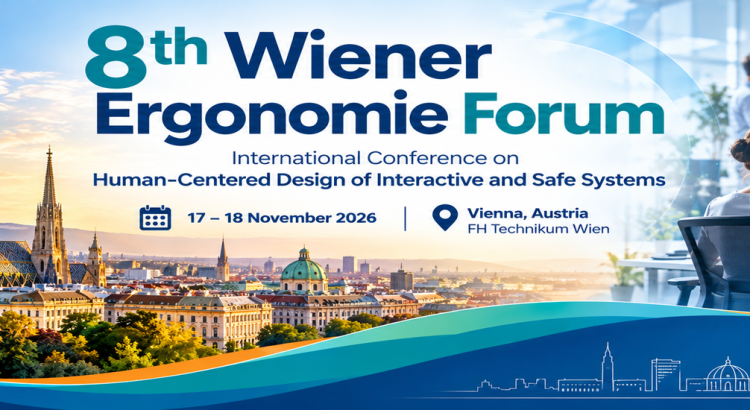
8th Wiener Ergonomie Forum 2026 – International Conference on Human-Centered Design

17–18 November 2026 | Vienna, Austria

The Federation of European Ergonomics Societies (FEES) is pleased to endorse the 8th Wiener Ergonomie Forum, taking place on 17–18 November 2026 at the University of Applied Sciences Technikum Wien, Austria.

Organised by the Austrian Ergonomics Society (ÖAE), together with UAS Technikum Wien, BOKU University and the IEA Technical Committee for Safety and Health, the conference will bring together researchers, practitioners, policymakers and students to discuss current developments in ergonomics and human factors.

Under the theme “Human-Centered Design of (Interactive and Safe) Systems”, the programme will address occupational safety and health, user experience, safety engineering, Industry and Society 5.0, healthcare transformation, and education in ergonomics.

Building on the successful previous editions of the Wiener Ergonomie Forum, the 2026 event will offer keynote presentations, scientific contributions, practical workshops and opportunities for international professional exchange.

FEES warmly welcomes this initiative and encourages members of European ergonomics societies to participate and contribute.

Further information, programme and registration:

https://www.technikum-wien.at/wiener-ergonomieforum

Federation of European Ergonomics Societies within the Community of Practice on Industry 5.0

The Community of Practice on Industry 5.0 (CoP 5.0) is a European network of experts, researchers, and industrial stakeholders established by the European Commission. Its mission is to jointly develop, test, and disseminate the principles of Industry 5.0 by fostering collaboration, exchanging best practices, and supporting policy development that connects industry, society, and sustainable development. In 2024, the Federation of European Ergonomics Societies (FEES) became an official member of CoP 5.0.

FEES joined CoP 5.0 to actively promote the human-centric approach as a core element of Industry 5.0. Ergonomics is, by definition, a human-centric scientific discipline that focuses on the interaction among humans, machines, and the working environment. Human-centred design is a key area of ergonomics, and ergonomic principles play a critical role in shaping industrial systems that are aligned with human capabilities, limitations, and well-being.

From an ergonomic perspective, the contribution to Industry 5.0 can be highlighted through several key aspects:

Inclusion of human operators

Ergonomic principles emphasise integrating human factors into the design of equipment, technologies, and work processes. By considering human strengths and limitations, industrial systems can achieve higher levels of safety, efficiency, and usability, thereby contributing to more sustainable, operator-friendly solutions.

Utilisation of workplace expertise

FEES recognises the value of workers’ practical knowledge and experience. The human-centric approach of Industry 5.0 encourages employees to actively identify problems and co-develop solutions, ensuring that innovations are grounded in real working conditions.

Team involvement and participation

Ergonomics supports participatory approaches in which teams are directly involved in the design and optimisation of industrial systems. This participation improves the quality and relevance of solutions and strengthens workers’ sense of ownership and responsibility.

Balanced use of technology

While advanced technologies are essential, FEES emphasises their ethical and responsible integration. Ergonomics ensures that technology complements human work rather than overshadowing it, helping to prevent negative effects such as excessive workload, stress, or alienation.

Through its participation in CoP 5.0, FEES aims to ensure that ergonomic principles underpin the human-centric transformation of industrial systems, aligning technological development with human well-being, organisational productivity, and societal values. As a multidisciplinary scientific field, ergonomics also contributes to the development of resilient, sustainable industrial systems.

Within CoP 5.0, Prof. Aleksandar Žunjić, Secretary-General of FEES, together with Dr Sebastian Capotescu (ErgoWork Society of Romania), were selected by the European Commission as a member of the expert working group Business Case 5.0 for Sustainable Competitiveness. This group, in close cooperation with the Hubs 5.0 working group, supports the development and promotion of Industry 5.0 under the Directorate-General for Research and Innovation of the European Commission.

As an outcome of the work carried out within the Business Case 5.0 for Sustainable Competitiveness expert group, Aleksandar Žunjić and Sebastian Capotescu published four scientific papers in 2025 addressing the role of the human-centric approach and human factors in achieving the sustainability objectives of Industry 5.0:

  • Zunjic, A., Capotescu, S., Cuevas-Lopez-de-Baro, C., Cordea, C., Lukic, P. V. M. (2025). Contribution of the human-centric approach to environmental, social and economic sustainability. IETI Transactions on Engineering Research and Practice, Vol. 9, Issue 1, pp. 1–10.
  • Zunjic, A., Capotescu, S., Cuevas-Lopez-de-Baro, C., Cordea, C., Yue, X.-G. (2025). Contribution of the human-centric approach to technological, resource and innovation sustainability. IETI Transactions on Engineering Research and Practice, Vol. 9, Issue 1, pp. 11–22.
  • Zunjic, A., Capotescu, S., Cuevas-Lopez-de-Baro, C., Cordea, C., Yue, X.-G. (2025). Contribution of the human-centric approach to organizational, market, and health sustainability. IETI Transactions on Engineering Research and Practice, Vol. 9, Issue 1, pp. 23–34.
  • Capotescu, S., Zunjic, A., Cuevas-Lopez-de-Baro, C., Cordea, C. (2025). Human factor as central approach in a sustainable business model for Industry 5.0. IETI Transactions on Ergonomics and Safety, Vol. 9, Issue 1, pp. 22–45.

Ergonomics and Human Factors at the Centre of the Digital Transformation

As an official partner of the European Agency for Safety and Health at Work (EU-OSHA), the Federation of European Ergonomics Societies (FEES) proudly supports the 2023–2025 Healthy Workplaces Campaign: Safe and healthy work in the digital age. This initiative highlights the growing role of smart digital systems in improving occupational safety and health (OSH) across Europe.

From an ergonomics and human factors perspective, smart digital technologies—such as wearable devices, sensor networks, AI-driven analytics, and virtual reality training platforms—have significant potential to enhance workplace safety, health, and well-being. These tools enable early identification of ergonomic risks, provide real-time data on physical strain and environmental hazards, and support timely interventions. They are especially valuable in high-risk industries and for vulnerable worker groups, including older employees and those with specific health conditions.

However, digital systems must be implemented according to user-centred design principles to be practical and ethically sound. FEES stresses the importance of involving workers and their representatives in designing, deploying, and monitoring these technologies. Transparent communication, responsible data management, and training are essential to building trust and acceptance. When workers understand and influence digital tools, safety, satisfaction, and engagement improve significantly.

At the same time, we must remain vigilant about the challenges posed by digitalisation. Over-reliance on automation, excessive monitoring, lack of usability, and insufficient training can lead to new psychosocial risks such as stress, cognitive overload, and mental fatigue. Smart systems should always complement, not replace, traditional OSH strategies like ergonomic workplace design, inclusive organisational policies, and direct human support.

As FEES, we advocate for integrating digital innovation with ergonomic principles to create safe, inclusive, and sustainable workplaces. We call on our member societies, researchers, practitioners, and partners to actively contribute to this campaign by sharing knowledge, good practices, and critical reflections on the human-centred use of smart technologies in OSH.

PARTICIPATORY (RE)DESIGN OF A SOFTWARE SYSTEM

Dr. Daniel Felix Eur.Erg.
http://www.easy-to-use.ch/

About ERGONOMICS PRACTICE EXAMPLES

The field of practice of professional ergonomists is very wide and covers all aspects concerning the health, well-being and productivity of people at work. Some ergonomic interventions concentrate on designing workplaces so that the work can be done comfortably and safely over a long period. Others look at the safety and ease of use of tools and computer interfaces. Others look at the organization of work systems to optimize workflow and avoid errors.

These papers do not cover all the areas of ergonomics practice, but they may be helpful for people looking for examples of how a professional ergonomist provides solutions for companies wanting to improve the efficiency of their workers without decreasing their safety, health, or well-being.

CONTRIBUTORS

The examples published here were contributed by European Ergonomists and reviewed by representatives from the Centre for Registration of European Ergonomics (CREE) and by the Federation of European Ergonomics Societies (FEES).

FFES Logo

If you are a certified ergonomist and wish to contribute, please get in touch with a member of the executive board of CREE or FEES. Contributions are welcome, and no fee is charged.