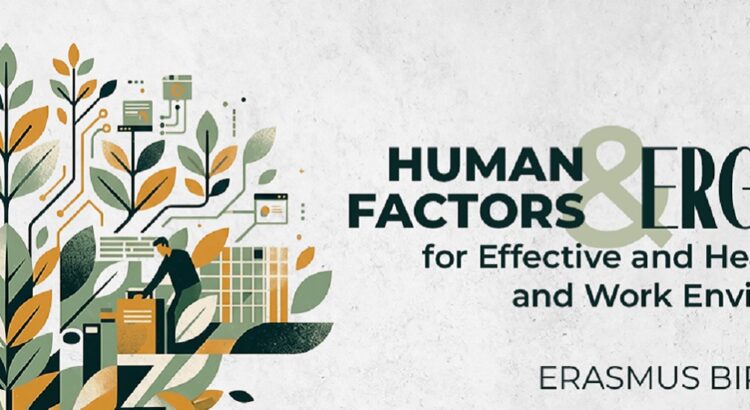
Human Factors and Ergonomics for Effective and Healthy Learning & Work Environment

Human Factors and Ergonomics for Effective and Healthy Learning & Work Environment

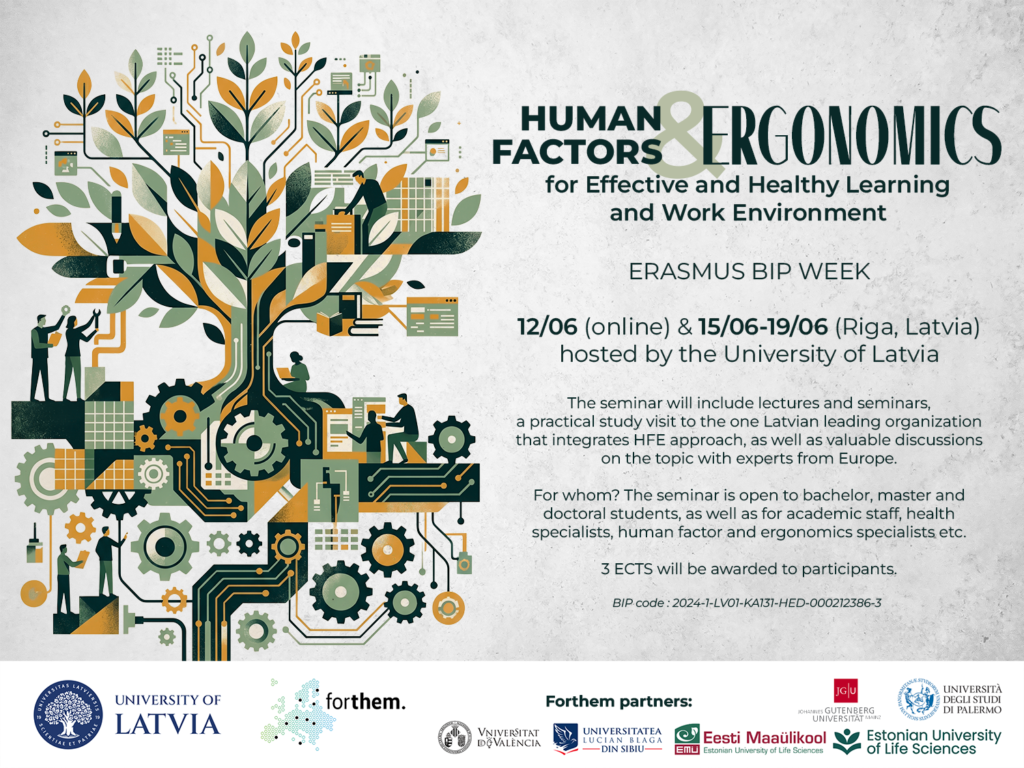
FEES is pleased to highlight the ERASMUS+ BIP Week “Human Factors and Ergonomics for Effective and Healthy Learning & Work Environment”, organised at the University of Latvia in Riga.

The programme will take place in a blended format, with an online session on 12 June 2026 and an onsite week from 15 to 19 June 2026. It focuses on interdisciplinary teaching, applied practice, and international experience exchange in human factors and ergonomics.

The agenda covers contemporary topics such as workplace ethics, mental well-being and burnout, psychosocial risk assessment, indoor air quality and health, and human–AI team collaboration. The onsite programme also includes a practical company visit to Rīgas Satiksme, linking theoretical knowledge with real workplace applications.

This initiative is a good example of how ergonomists can use European support schemes to promote healthier, more effective, and more human-centred learning and work environments.

Further information: Kristine Kursite-Germane, University of Latvia — kristine.kursite-germane@lu.lv

COMBINING THE EXPERTISE OF WORKERS WITH OBJECTIVE MEASURES

Veli-Matti Tuure
www.tts.fi

About ERGONOMICS PRACTICE EXAMPLES

The field of practice of professional ergonomists is very wide and covers all aspects concerning the health, well-being and productivity of people at work. Some ergonomic interventions concentrate on designing workplaces so that the work can be done comfortably and safely over a long period. Others look at the safety and ease of use of tools and computer interfaces. Others look at the organization of work systems to optimize workflow and avoid errors.

These papers do not cover all the areas of ergonomics practice, but they may be helpful for people looking for examples of how a professional ergonomist provides solutions for companies wanting to improve the efficiency of their workers without decreasing their safety, health, or well-being.

CONTRIBUTORS

The examples published here were contributed by European Ergonomists and reviewed by representatives from the Centre for Registration of European Ergonomics (CREE) and by the Federation of European Ergonomics Societies (FEES).

FFES Logo

If you are a certified ergonomist and wish to contribute, please get in touch with a member of the executive board of CREE or FEES. Contributions are welcome, and no fee is charged.