Echoes from the 52nd SELF Congress held in Toulouse- September 2017

At the opening of the 52nd SELF Congress held in Toulouse (France) took place in a plenary session a round table on the issue : «ergonomics beyond our borders : which lessons for our development ?» where were presented : a reflection on the French language ergonomics peculiarities (Pierre Falzon) with the specificity of the field studies, the synthesis of the SWOT enquiry on the development of ergonomics in Europe and beyond (Sylvain Leduc – results coming soon on the FEES website) which shows the remaining discrepancy between ergonomic knowledge and its implementation in the systems desig

At the opening of the 52nd SELF Congress held in Toulouse (France) took place in a plenary session a round table on the issue : «ergonomics beyond our borders : which lessons for our development ?» where were presented : a reflection on the French language ergonomics peculiarities (Pierre Falzon) with the specificity of the field studies, the synthesis of the SWOT enquiry on the development of ergonomics in Europe and beyond (Sylvain Leduc – results coming soon on the FEES website) which shows the remaining discrepancy between ergonomic knowledge and its implementation in the systems design. A debate followed the lectures with four ergonomists from various countries where French ergonomics is implemented: Alain Piette (Belgium) explained that, although ergonomics has been included in the OSH regulations in Belgium, its implementation in the companies faced serious difficulties; Bénédicte Calvet (Canada / Québec) mentioned an interesting development of ergonomics in the companies. According to her views, a solution could be an integration of ergonomics in OHS; Chico Duarte (Brazil) recorded the important spreading of the activity ergonomics in his country but the present crisis in the Government and in the University was for the time being a factor which was not favorable to its development; Pascal Etienne (France) explained that in front of the stake for the future of ergonomics in France and in order to answer the question “what the society does expect from ergonomists ?”, the dialogue with the global ergonomics inside FEES or IEA could be a real lever.

The Congress gathered 580 attendees. 84 lectures were presented, as well 6 symposia (including 24 lectures on a whole) and 10 round tables on the ergonomists practices, on various activity fields and the ways for ergonomics to be recognized. Keynote speeches in plenary sessions presented enlightening reflections on the future of work: two conferences on the issue «from past work to future work: which risk or levers to build health?» : Thomas Coutrot (economist) presented the prospective work achieved with INRS on the issue “production modes and methods in France in 2040” and Alain Garrigou (ergonomists) spoke on the issue : “ergonomics facing the burn out society”. Eric Brangier (ergonomist) explained ideas coming from the «prospective ergonomics» on the issue « future, innovation, ergonomics». Such way of doing will be presented in a symposium in the frame of the IEA 2018 congress in Florence.

Bimingham meeting

Hilton Manchester Airport, UK

IEHFThe Chartered Institute of Ergonomics and Human Factors is organising events answering the most recent safety related issues.

Human Factors in Nuclear Decommissioning

16 October 2017
Hilton Manchester Airport, UK

Britain today faces one of the most complex, long-term, environmental challenges – that of decommissioning 17 nuclear sites. It’s Europe’s largest remediation programme, and will take decades. In all, 10,000 plants and buildings will be demolished.

This work falls to the Nuclear Decommissioning Authority (NDA) to organise and includes the first generation of Magnox power stations, various research and fuel facilities, and the largest, most complex site, Sellafield where all nuclear fuel reprocessing will end by 2020.

Work has already started and for the first time ever contaminated waste is being retrieved from the highest hazard facilities at Sellafield. At other sites, defueling – the removal of all nuclear fuel – will soon be completed.

This work involves some advanced machinery but mostly it involves people – 16,000 of them over the 17 sites. So, what are the human factors issues that need to be addressed in order to achieve the NDA’s objective? What skills can human factors practitioners bring to ensure these issues are investigated and dealt with effectively and sustainably?

The Chartered Institute of Ergonomics and Human Factors is organising an event that concentrates on answering these questions. ‘Human Factors in Nuclear Decommissioning’ will take place on 16 October 2017 at the Hilton Manchester Airport, UK and will bring together regulators, consultants, site licence companies and anyone with an interest in decommissioning in high-hazard industries.

Speakers will discuss human factors challenges and opportunities across all areas of decommissioning, from setting out safety cases to dealing with radiological hazards through protective equipment.

For more details visit http://events.ergonomics.org.uk/event/human-factors-in-nuclear-decommissioning/.

Human Factors in Aviation Safety

13-14 November 2017
Hilton London Gatwick Airport, UK

The BBC reported recently that air traffic controllers expect to manage a record 770,000 flights in UK airspace over the summer – 40,000 more than last year. The report also announced that the government is launching a consultation process to shape the UK’s aviation industry for the next 30 years. See http://www.bbc.co.uk/news/business-40669144. The consultation will include 6 themes, one of which is safety and security, and another is innovation, technology and skills. Both of these themes will be discussed in detail at the ‘Human Factors in Aviation Safety’ event in November, organised by the Chartered Institute of Ergonomics and Human Factors.

The programme for this two-day event includes presentations, posters and discussions covering human performance, adaptive automation, remote operations, fatigue and maintenance. The question we will look to answer is: How do we improve human performance in today’s aviation business?

This event sponsored by Sponsore by NATS

Representatives from airlines, air traffic control organisations, industry regulators and investigators, consultants and the major university research groups will be taking part, examining a range of human factors issues in aviation safety in both the military and commercial sectors

‘Human Factors in Aviation Safety’ will take place on 13-14 November 2017 at the Hilton London Gatwick Hotel at Gatwick Airport’s South Terminal, also the terminus for the 30 minute Gatwick Express rail service from London Victoria.

See the full programme and all details about how to book at http://events.ergonomics.org.uk/event/human-factors-in-aviation-safety-3/

Endorsed by FEES

These events are endorsed by the Federation of European Ergonomics Societies. FEES members are welcome to attend this event at a 20% discount off standard delegate rates. Use code FEES20 to obtain your discount when you register.

Summary of the European conference on Workers and creativity: How to improve working conditions by participative methods” organised by FEES, ETUI, BES and CREE and held in Brussels on 26-27 June 2017

The conference “Workers and creativity: How to improve working conditions by participative methods” organised jointly by the Federation of European Ergonomics Societies (FEES), the European Trade Union Institute (ETUI), the Belgian Ergonomics Society (BES) and the Centre for Registration of European Ergonomics (CREE) with the support of the International Ergonomics Association (IEA) was attended by around one hundred participants, including ergonomists, union officials, company doctors and H&S officers.

The conference “Workers and creativity: How to improve working conditions by participative methods” organised jointly by the Federation of European Ergonomics Societies (FEES), the European Trade Union Institute (ETUI), the Belgian Ergonomics Society (BES) and the Centre for Registration of European Ergonomics (CREE) with the support of the International Ergonomics Association (IEA) was attended by around one hundred participants, including ergonomists, union officials, company doctors and H&S officers.

BES LogoThis conference saw some twenty papers being given by European experts in the field of ergonomics and industrial relations, presenting a panorama of working conditions in Europe and pointing to ways of developing participative approaches to unleash the creativity of workers and organisations (cf. the summary of each presentation on the FEES http://ergonomics-fees.eu and ETUI https://www.etui.org).

The conference was the result of a European-level cooperation between the four organisations (FEES, ETUI, BES and CREE), with the support and participation of the IEA and the presence of the European bodies involved.  Three sessions were dedicated to reviewing the state of play with regard to working conditions in Europe, presenting examples of ways of transforming working conditions and triggering creativity through participating workers. The sessions were interspersed by presentations given by ergonomists and workers’ representatives.

State of play

Following the welcoming speeches of the organisers, the European Commission’s representative Mario GABRIELLI COSSELLU,  from DG Growth gave a presentation on the legislative framework in force at EU level, stressing that the so-called “New Approach” directives were not that rigid: based on basic health & safety requirements, the legislation was open to innovation and worker creativity resulting from their practical experience in production and in the use of facilities, in particular from a working conditions point of view and the associated ergonomic aspects. The “machinery” directive in particular contained clauses related to ergonomics, and the “feedback method” (presented during this conference) was producing very encouraging results based on workers’ participation.
Download the presentation here.

Agnès PARENT-THIRION, researcher at the European Foundation for the Improvement of Living and Working Conditions (Eurofound)  presented several key findings of the sixth European Working Conditions Survey conducted in 2015 in 35 countries and focused on the quality of work, an aspect which has many dimensions, including the physical environment, work intensity, working hours, the social environment, etc. and the implementation of certain forms of “discretion” (supervised autonomy at work). This survey thus helped identify different profiles representing different types of jobs from a quality of work perspective. For more information: http://bit.ly/6EWCSReport.
Download the presentation here.

Patricia VENDRAMIN, sociologist from the Université Catholique de Louvain presented her work on ageing and working conditions in Belgium, referring to the data from the previously presented European survey: the general finding was that keeping people in work was becoming increasingly difficult due to workforce ageing and the wish to progressively reduce working time to compensate for difficult working conditions. Again, autonomy in organising work was seen as a factor favouring sustainable work. This survey underlined the wish, present in all age groups, to stop working at 60 (60% of those surveyed), with factors favouring sustainable work including work autonomy, possibilities of expressing one’s opinion, the support of line management and career opportunities.
Download the presentation here.  

Teresa COTRIM, professor of ergonomics at the University of Lisbon, presented data on workforce ageing in Portugal, based mainly on a survey of cemetery workers in Lisbon. This questionnaire-based participative survey took place in three steps: training sessions for members of the health & safety department, their gathering of data, and a discussion of the results and recommendations with all participants. The main recommendations for developing work aptitude were: the management of emotions and conflicts, teamwork, the prevention of MSD risks, preventive maintenance of gravediggers’ equipment, the redesign of cemetery layouts and acknowledgement of the social role of gravediggers. The overall conclusion was that there was no comprehensive health & safety culture.
Download the presentation here.

Henrijs KALKIS, ergonomist and professor at the  University of Riga in Latvia, gave a presentation on the main characteristics of Latvian working conditions, where a major rise in MSD cases has been registered over the past ten years. Among the various causes of bad working conditions, such as work processes involving difficult handling and stressful working postures, or the lack of worker involvement in decision-making, he highlighted the lack of understanding among companies and managers about what a “safety culture” means.  He insisted on the role of management and management methods (in particular lean management) for ensuring favourable working conditions from a health point of view, and for promoting employee creativity.
Download the presentation here.

Risto TOIVONEN, an ergonomist from the Finnish Ergonomics Society, described working conditions in Finland – similar to those found in the other Nordic states – on the basis of the Eurofound survey and national statistics. These were characterised by possibilities to learn at work and implement new ideas, by flexible working hours and moderate work intensity (but also by frequent interruptions of tasks and disturbing emotional situations), by fair treatment and help and support from line management and colleagues. In terms of the physical environment, the main problems were noise, low temperatures and repetitive movements.
Download the presentation here.

Winding up this first session, José Orlando GOMESergonomist and IEA vice-president, highlighted the need to design workplaces and situation matching individual workers, whatever their characteristics – older workers, young workers – and not to go for one-size-fits-all solutions. This necessity for a comprehensive approach meant a lot of work for ergonomists. He outlined the framework model promoted by the IEA, which Yushi Fujita would be going into in his presentation. Moving forward in an upward spiral, this model’s point of departure is science (comprising the generalisation, the definition of principles, new paradigms, etc.). From there it moves on to practice (analysing and solving problems, checking, unearthing new problems, standardisation, etc.), before returning to science via the new problems and new hypotheses.

Worker participation

Fabio STRAMBI, ETUI adviser for ergonomics and standardisation, and Massimo BARTALINI, from Tuscany local health unit USL presented worker participation in Italy, focusing on the design of machines using the “feedback method”. Within the context of implementing the Machinery Directive, the authors developed a methodology for the feedback of on-the-ground experience. Basing their work on European and global standards (in particular EN 614 and ISO 12 100) and on ergonomic principles, the two researchers mobilised the competences of workers allowed to express their criticism and suggestions regarding the design of different types of machinery (for example mobile machines, seat restraints, or manual or foot-operated control devices) with a view to improving technical standards. The methodology and the results of this approach are available in a CEN document (TR 1670-1) and on the Ergomach website: https://ergomach.wordpress.com/.
Download the presentation here and here.

Eloïse GALIOOT & Ludovic PONGE, ergonomics consultants in France, presented their thoughts emerging from the “staff representatives and risk prevention” (RP2) commission of the SELF on the relationship between ergonomists and workers’ representatives on the basis of expert reports compiled at the request of staff representatives. This specifically French scheme allows various resources in and outside a company to be mobilised. Using two examples, one from an abattoir and one from a branch of a bank, the authors showed how it is possible, starting out with a favourable context, using on-the-ground observations and moving on to design an intervention, to develop worker discretion and exploit their know-how and that of the CHSCT, the representative body responsible in companies for health and safety. In both cases, it proved possible to argue in favour of sustainable changes in the way work was organised.
Download the presentation here.

David WALTERS, a sociologist from the University of Cardiff in the United Kingdom, presented the results of his research, conducted as part of the ESENER survey, into workers’ involvement as practised in different EU countries. In his view, there were two distinct types of involvement – direct and indirect (via the employee representation body).  His finding was that the latter’s involvement in health and safety matters helped improve workplace health and company performance. For such representation to be effective, certain pre-conditions had to be met: regulatory measures, a committed management, regulatory inspections, workers’ support and union support for representatives. However, management moves were increasingly tending to side-line employee representation bodies and turn them away from their representation role, resulting in a decline in the support provided by staff representatives, the introduction of behaviour-based safety (BBS) systems and staff fragmentation.  The emergence of this “New orthodoxy” needed to be discussed within the trade union movement.
Download the presentation here.

ETUI jobsETUI researcher Tony MUSU, presented the union cooperation project on occupational cancers, looking at the case of chemical products. Based on a network of some 40 union experts, most of them members of European Advisory Committee on Health and Safety at Work or the European Trade Union Committee on Safety and Health at Work, an information, coordination and training project had been carried out, resulting in the design and conduct of action campaigns in various EU member states. Union proposals for preventing occupational cancers had been formulated, such as promoting policies for substituting carcinogenic agents, the systematic collection of data or the introduction of a consistent regulatory framework in this field.
Download the presentation here.

Xabier IRASTORZA, a researcher working at the  European Agency for Safety and Health at Work (EU-OSHA) presented “workers’ involvement in health and safety at work: results of the ’European Survey of Enterprises on New and Emerging Risks (ESENER) – The case of MSDs”. 

Conducted in 36 countries in 2014 and involving interviews with people with knowledge of working conditions within companies (managers and employees involved in health and safety), the survey provides data on the main risks confronting companies and what they are doing about them. With regard to preventing MSD risks for example, the promotion of such measures as introducing appropriate equipment, organising working time or job rotations is significantly higher in companies with an employee representation body.
Download the presentation here.

What about creativity?

IEAYushi FUJITA, ergonomics professor and consultant in Japan and president of the IEA, expounded the characteristics of this discipline at the crossroads of science and practice and aimed at improving performance and well-being. Based on his project experience in industry with regard to such questions as alarm management or the introduction of robots, his finding was that engineers had too little knowledge of shop-floor conditions and needed to know more. This was why it was necessary to develop “translations”, i.e. processes establishing links between humans and machines. This was what ergonomics was all about – the science of developing a coherent symbiosis to promote creativity. Winding up his presentation, Yushi Fujita put forward the following suggestions for developing ergonomics: widen its scientific base, go beyond its traditional frontiers (out of the box), contribute to reducing costs, and change traditional design and regulatory approaches through a long-term strategy.
Download the presentation here.

Giulio TOCCAFONDI, responsible for quality within the Clinical Risk Management Unit at the Tuscan Regional Authority in Italy, presented his thoughts on “creativity in practice”, referring to the factors he saw as influencing innovation in Italy. His finding was that routine tasks at work were decreasing, while at the same time intellectual and social activities, as well as those linked to the new communication technologies, were increasing. Creativity could be defined in two ways: “internal”, i.e. via a mental process in an individual; and “interactive”, a process triggered by external suggestions, via interactions with objects, other persons or operations. Confronted with creativity, ergonomics had to be aware of both the problems and opportunities it generated. The role of ergonomics was thus to encourage the development of creativity by introducing into work a certain sustainable degree of chance and uncertainty permitting creativity. All these issues would play a leading role at the IEA Congress, to be staged next year in August 2018 by the Italian Ergonomics Society in Florence.
Download the presentation here.

Bénédicte MOUTIN, Secretary General of the French CFDT union, presented the results of the “Parlons travail” survey conducted in 2016 in France in companies where the CFDT is represented. Given that the public debate has little to do with work, a large-scale survey was decided and conducted with the support of researchers. Some 200,000 people responded online. This survey revealed the great need for employee involvement and greater democracy at work. In the view of the respondents, quality of life at work was a fundamental issue and they yearned for greater autonomy in their work. Certain negative aspects were emphasised: the large amount of time spent on reporting or the little consideration shown by managers for their subordinates. An agreement has been reached that the data collected during the “Parlons travail” survey is going to be made available to researchers, who will in return present their research findings to the CFDT. The process will end with the compilation of a CFDT “Manifesto for work”.
Download the presentation here.

Théo MOULIERES-SEBAN, an engineering researcher working for  Safran, the French aviation company, gave a paper entitled “the cobots, questions related to working together with robots”. In his research on the introduction of collaborative robots (“cobots”) in industry, he found that, due to the fact that normative supervision had evolved, interactions between robots and operators was now possible. What was now needed was to develop the criteria for participative design, taking account of safety requirements through formalising the work of the operators and defining use scenarios via simulations. In a concrete situation, that of cleaning a tank, he had established a working group made up of operators, supervisors, the project leader, a methods officer and the head of maintenance. This had been able to analyse the work and come up with a simulation of what the work would look like in the future, with the operator working together with a robot. The technical specifications, system roll-out, training courses, etc. have since been defined. The process is now in the course of being implemented.
Download the presentation here.

Steve BARRACLOUGH, head of the UK Chartered Institute of Ergonomics and Human Factors, gave a paper entitled “Stronger together: human factors, safety and productivity”. This presented the results of research covering 1000 professionals and companies on their perception of automation and robotics and the associated shop-floor reality. The main results of this survey are as follows: 47% of workers in industry are of the opinion that there has been an increase in the automation of their working environment over the past few years. The majority of companies (66%) responded that they had automated their processes, while 74% of professionals anticipated that the degree of automation would rise in the future. Against this background, ergonomists could show their skills, but would have to be even more flexible, inventive and available to make sure that work and working conditions improved, both for employers and workers, demonstrating their ability to achieve a symbiosis between workers and automation.
Download the presentation here.

The main points debated during the conference

Numerous issues were raised and discussed during this conference:

  • That of the conditions necessary for involving operators. For involvement to be effective, operators’ training reality and acceptance of technological change needed to be aligned with management’s acceptance of suggestions coming from them. They needed opportunities to voice their opinions and be heard, with the latter reflected in changes in the short or medium term.
  • That of highlighting these real-life experiences of industrial democracy in the social debate: is industrial democracy just an island or is the issue being dealt with more broadly in society, for example in regional or national employers’ associations, in trade unions or by local health authorities? 
  • That of extending such actions to professional sectors at a national or even EU level in terms of including best practices, training and/or change management aspects in regulations (or technical norms) covering health and safety or social dialogue.
  • That of the link between direct and indirect participation via employee representation bodies: was it antagonistic or complementary? Did it fuel the debate on the role of representative bodies specialised in health and safety at work? 
  • That of the link between discussions on workplace creativity and the introduction of new technologies such as collaborative robots or new ICT developments in companies and their rapid uptake by society: were these parallel developments dominated by market logic or by evolution, were they properly controlled, were they based on shared and debated principles, were prevention strategies available, had the social utility of the technologies been debated? 
  • That of national contexts (technological, social, cultural) which still required an in-depth exchange of information between scientists (especially ergonomists), trade unionists and company heads to overcome linguistic and cultural barriers and ultimately to arrive at a true understanding with shared perceptions. This had been seen in the different aspects and points of view presented during the conference, including ergonomics, worker involvement, creativity, automation, etc.

FFES LogoWinding up,  Sylvain LEDUC, president of the FEES, emphasised that these papers demonstrated the effects of work, both real and represented. For instance, the often-harmful side-effects of work were still present, though in a different form and with a better picture of the costs involved. These papers also provided an overview of the know-how available in the field of ergonomics, but without necessarily taking account of ergonomists’ knowledge. Moreover, with regard to worker involvement, two questions needed to be raised: Was this a case of representative involvement – i.e. aiming to effectively involve the workers concerned – or a case of participatory representation – i.e.  bringing together those with a representative function in social dialogue?

Beyond that, it seemed that this problem of creativity and worker involvement required certain pre-conditions to be defined: the development of methods for updating real-life work processes, with a view to upgrading the key determinants of creativity. More work needed to be put into defining the shape of future work on the one hand and the future of work and how it is organised on the other hand. In this context, automation raised the question of how production was organised. But what was really at stake was the issue of work transformation and the need for worker involvement to arrive at solutions helping to improve working conditions. Two paths needed to be explored: that of new forms of management involving “particreativity” and that of the scope of simulation for coping with uncertainty and unexpected situations. But one question remained: how to go beyond regulation – the limits of which were clearly seen, leading it to be questioned – and get company decision-makers to take account of shop-floor reality.

Pascal Etienne, FEES Secretary General
17 July 2017

Synthèse de la conférence européenne à Bruxelles, les 26 & 27 juin 2017 : « Travailleurs et créativité : comment améliorer les conditions de travail par des méthodes participatives ? » organisée par FEES, ETUI, BES et CREE

Le conférence organisée conjointement par la Fédération européenne des sociétés d’ergonomie (FEES), l’Institut syndical européen (ETUI), la société belge d’ergonomie (BES) et le centre d’enregistrement du titre d’ergonome européen (CREE) avec le soutien de l’Association internationale d’ergonomie (IEA) sur la thématique « Travailleurs et créativité : comment améliorer les conditions de travail par des méthodes participatives » a rassemblé une centaine de participants (ergonomes, syndicalistes, médecins du travail, responsables d’entreprises,…).

Le conférence organisée conjointement par la Fédération européenne des sociétés d’ergonomie (FEES), l’Institut syndical européen (ETUI), la société belge d’ergonomie (BES) et le centre d’enregistrement du titre d’ergonome européen (CREE) avec le soutien de l’Association internationale d’ergonomie (IEA) sur la thématique « Travailleurs et créativité : comment améliorer les conditions de travail par des méthodes participatives » a rassemblé une centaine de participants (ergonomes, syndicalistes, médecins du travail, responsables d’entreprises,…).

BES LogoCette conférence a donné lieu à une vingtaine de communications par des experts européens du domaine de l’ergonomie et des relations sociales qui ont présenté un panorama des conditions de travail en Europe et tracé des pistes pour le développement d’approches participatives permettant de libérer la créativité des travailleurs et des organisations (cf. le résumé de chacune des présentations sur les sites de FEES http://ergonomics-fees.eu et de ETUI https://www.etui.org).

Cette conférence est le résultat d’un processus de coopération initié au niveau européen entre ces quatre organisations (FEES, ETUI, BES et le CREE), avec le soutien et la participation de l’IEA et la présence des organismes européens concernés. Trois sessions ont été successivement dédiées à un état des lieux des conditions de travail en Europe, à la présentation d’exemples de contributions à la transformation des conditions de travail et de mise en œuvre de procès de créativité à travers la participation des travailleurs, médiée par des interventions d’ergonomes ou de représentants du personnel.

Un état des lieux

Après des discours d’accueil des organisateurs, le représentant de la Commission Européenne, Mario GABRIELLI COSSELLU, administrateur de la direction générale « Croissance », a souligné que le cadre législatif en vigueur au niveau communautaire, celui des directives dites de la « Nouvelle Approche », n’était pas rigide : fondée sur des « exigences essentielles de santé et de sécurité », la législation est ouverte à l’innovation et à la créativité des travailleurs, sur la base de leur expérience pratique de la production et de l’utilisation des équipements, en particulier du point de vue des conditions de travail et des aspects ergonomiques qui leur sont liés. La directive « machines », en particulier, contient des prescriptions relatives à l’ergonomie et la « méthode feedback », présentée au cours de la présente conférence, a produit des résultats très positifs sur la base de la participation des travailleurs.

Agnès PARENT-THIRION, chercheure à la Fondation européenne pour l’amélioration des conditions de travail (Eurofound) a présenté quelques éléments clés de la sixième enquête européenne sur les conditions de travail réalisée en 2015 dans 35 pays par cette Fondation, centrée sur la qualité au travail : la qualité du travail qui est multi-dimensionnelle a comme composantes, par exemple, l’environnement physique, l’intensité du travail, la durée du travail, l’environnement social,… et la mise en œuvre de certaines formes de « discrétion » (autonomie encadrée dans le travail). Avec cette enquête on peut ainsi identifier différents types de profils représentant différents types de jobs du point de vue de la qualité du travail. Pour en savoir plus : http://bit.ly/6EWCSReport .

Patricia VENDRAMIN, sociologue de l’Université Catholique de Louvain présente ses travaux sur le vieillissement et les conditions de travail en Belgique, déclinant les données de l’enquête européenne présentée précédemment : le constat général est celui du maintien au travail de plus en plus difficile du fait de l’avancée en âge et un souhait de réduction progressive du temps de travail pour compenser la pénibilité au travail. Comme précédemment, l’autonomie dans l’organisation du travail est pointée comme un facteur favorable pour assurer un travail soutenable. Cette enquête souligne, pour tous les groupes d’âge, le souhait d’arrêter de travailler à 60 ans (60 % des enquêtés), les facteurs favorables à la soutenabilité du travail étant son autonomie, les possibilités d’expression, le soutien de la hiérarchie et les opportunités de carrière.

Teresa COTRIM, professeure d’ergonomie à l’université de Lisbonne, présente des données sur le vieillissement au travail au Portugal en s’appuyant notamment sur une enquête menée auprès de travailleurs des cimetières à Lisbonne. Cette enquête participative par questionnaires s’est déroulée en trois étapes : sessions de formation pour les membres du département de santé au travail, collecte de données par ces derniers et discussion des résultats et des recommandations avec tous les participants. Les principales recommandations pour développer l’aptitude au travail sont : le management des émotions et des conflits, la construction d’un travail d’équipe, la prévention des risques de TMS, la maintenance préventive des équipements des fossoyeurs, la reconception des emplacements des tombes et la reconnaissance du rôle social des fossoyeurs. En conclusion, le constat est qu’il manque une culture holistique en santé sécurité au travail.

Henrijs KALKIS, ergonome, professeur à l’Université de Riga en Lettonie, présente les grandes caractéristiques des conditions de travail en Lettonie avec une forte augmentation des TMS depuis une dizaine d’années. Parmi les différentes causes des mauvaises conditions de travail, telles que des procès de travail comprenant des manutentions difficiles et des postures de travail contraintes ou le manque d’implication des employés dans les prises de décision, il met l’accent sur le manque de compréhension de ce qu’est une « culture de sécurité » parmi les organisations et les managers. Il insiste sur le rôle du management et des méthodes de management (en particulier le lean management) pour assurer des conditions de travail favorables du point de vue de la santé et de la créativité des salariés.

Risto TOIVONEN, ergonome, de la société finlandaise d’ergonomie, décrit les conditions de travail en Finlande, qui sont similaires à celles des autres pays nordiques, sur la base des résultats de l’enquête Eurofound et des statistiques nationales. Elles se caractérisent par les possibilités d’apprendre dans le travail et de mettre en œuvre des nouvelles idées, par la flexibilité des temps de travail et une intensité du travail modérée, mais aussi par des interruptions fréquentes des tâches et des situations dérangeantes sur le plan émotionnel, un traitement équitable une aide et un soutien de la part de la hiérarchie et des collègues de travail. En termes d’environnement physique, les principaux problèmes signalés sont le bruit, les basses températures et les mouvements répétitifs.

José Orlando GOMES, ergonome, Vice-président de l’IEA, souligne, en conclusion de cette première session, la nécessité de concevoir des situations et des lieux de travail convenant à chaque personne, quelles que soient ses caractéristiques : travailleurs vieillissants, jeunes, … et non pas à une population standard. Une approche globale est donc nécessaire ce qui représente beaucoup de travail pour les ergonomes. Il esquisse ainsi le modèle d’action cadre promu par l’IEA qui sera développé également par Yushi Fujita dans son intervention. Ce modèle « qui avance en spirale » part de la science (comprenant la généralisation, la découverte de principes, de nouveaux paradigmes, etc.) vers la pratique (analyse, solution de problèmes, validation, découverte de problèmes, normalisation, etc.) et retour vers la science à travers de nouveaux problèmes, de nouvelles hypothèses.

Quelle participation des travailleurs ?

Fabio STRAMBI, conseiller de l’ETUI pour l’ergonomie et la normalisation & Massimo BARTALINI, de l’Unité sanitaire locale (USL) de Toscane présentent la participation des travailleurs en Italie à la conception des machines, avec la « méthode feedback ». Dans le cadre de la mise en œuvre de la directive relative à la conception des machines, les auteurs ont développé une méthodologie de retour d’expérience du terrain. Se fondant sur les normes européennes et mondiales (EN 614 et ISO 12 100, notamment) développant des principes ergonomiques, les chercheurs ont mobilisé les compétences des travailleurs qui ont pu exprimer sur le terrain leurs critiques et leurs propositions relatives à la conception de différents types de machines (par exemple pour des machines mobiles, les dispositifs de retenue sur les sièges, ou les dispositifs de commandes des machines, manuelles ou au pied) en vue de l’amélioration du contenu des normes techniques. Le contenu de la méthodologie et les résultats de cette démarche sont accessibles dans un document du CEN « TR 1670-1 » et sur le site Ergomach : https://ergomach.wordpress.com/.

Eloïse GALIOOT & Ludovic PONGE, ergonomes consultants en France, ont exposé leurs réflexions issues de la commission « représentants du personnel et prévention des risques (RP2) » de la SELF, sur la relation entre ergonomes et représentants des travailleurs, sur la base des expertises menées à la demande des représentants du personnel. Cette spécificité française permet de mobiliser des ressources diverses dans et hors l’entreprise. A travers deux exemples, dans un abattoir de bovins et dans une agence bancaire, les auteurs ont montré comment à partir d’un contexte favorable à la construction d’une intervention, il est possible, sur la base d’observations de terrain, de développer le pouvoir d’agir des travailleurs, de valoriser tout aussi bien le savoir des salariés et l’instance représentative qu’est le CHSCT. Dans les deux cas, il a été possible d’argumenter en faveur de changements durables dans l’organisation du travail.

David WALTERS, sociologue à l’Université de Cardiff au Royaume-Uni, a présenté les résultats de ses recherches sur la participation des travailleurs en pratique dans différents pays de l’Union européenne, dans le prolongement de l’enquête ESENER. Pour l’auteur, deux types de participation doivent être distinguées : la participation directe et celle via la représentation du personnel. Or il est constaté que la représentation du personnel en santé sécurité au travail améliore la santé au travail et la performance de l’entreprise. Pour que cette représentation soit effective, un certain nombre de conditions sont requises : des mesures réglementaires, un engagement du management, des inspections réglementaires, un soutien des travailleurs et un appui syndical aux représentants. Mais de plus en plus, les approches managériales tendent à marginaliser la représentation du personnel et à la détourner de son rôle représentatif, ce qui a comme conséquence un déclin du soutien aux représentants du personnel, la mise en place de systèmes de prévention basés sur les comportements individuels (« BBS : behavior-based safety ») et une atomisation des travailleurs. L’émergence de cette « nouvelle orthodoxie » nécessite une réflexion au sein du mouvement syndical.

ETUI jobsTony MUSU, chercheur à l’ETUI présente la coopération des syndicalistes contre les cancers professionnels avec le cas des produits chimiques. Sur la base d’un réseau d’une quarantaine d’experts syndicaux, pour la plupart membres du Comité consultatif européen en santé sécurité ou du Comité syndical européen en santé sécurité du travail, un travail d’échange d’information, de coordination et de formation a été réalisé, ce qui a permis l’élaboration et la conduite de campagnes d’action dans différents pays de l’UE. Sur cette base, des propositions syndicales pour la prévention des cancers professionnels ont pu être formulées, telles que la promotion d’une politique de substitution des agents cancérogènes, la collecte systématique de données ou la mise en place d’un réseau réglementaire cohérent dans ce domaine.

Xabier IRASTORZA, chercheur à l’Agence européenne en santé sécurité (EU-OSHA) a présenté : « l’implication des travailleurs en santé sécurité au travail : résultats de l’enquête européenne sur les entreprises et les risque émergents (ESENER) – Le cas des TMS ».

Réalisée en 2014 dans 36 pays sur la base d’entretiens auprès de personnes connaissant les conditions de travail de l’entreprise (managers et employés connaissant les questions de SST), l’enquête fournit des données sur les principaux risques auxquels sont confrontées les entreprises et sur leur prise en charge. Par exemple en matière de prévention des risques de TMS, la promotion de mesures telles que la dotation en équipements appropriées, des mesures en matière d’organisation du temps de travail ou de rotation des postes, est significativement plus élevée lorsqu’existe une représentation du personnel.

Quelle créativité ?
IEAYushi FUJITA, professeur en ergonomie et consultant au Japon, Président de l’IEA, dans son exposé sur « la créativité et l’innovation dans les entreprises : quelles implications pour les facteurs humains et l’ergonomie ? » a fait un rappel sur les caractéristiques de cette discipline qui articule science et pratique dans un objectif de performance et de bien-être. Sur la base de son expérience de conduite de projets dans l’industrie sur des questions telles que la gestion des alarmes ou la robotisation, il fait le constat que les connaissances des ingénieurs sont limitées et qu’ils ont besoin de connaître le travail réel. C’est pourquoi il est nécessaire de mettre au point des processus de « traduction » ou de construction de liens entre les hommes et les technologies. L’ergonomie est bien cette science du lien, un ensemble cohérent pour développer la créativité. En conclusion, Yushi Fujita fait des suggestions pour développer l’ergonomie : par exemple, l’amélioration de son fondement scientifique, le dépassement les frontières traditionnelles de la discipline, la contribution à la réduction des coûts, ou le changement des approches traditionnelles de la conception et de la réglementation avec une stratégie à long terme.

Giulio TOCCAFONDI, chargé de la qualité au sein de l’Unité du management du risque clinique de la Région toscane en Italie, a présenté une réflexion sur « la créativité en pratique ». Cette notion fait référence à l’enjeu de l’innovation tel qu’il est perçu en Italie. Le constat est que, dans le travail, les tâches routinières sont en déclin et qu’en parallèle les activités intellectuelles, sociales et celles liées aux nouvelles technologies de la communication progressent. La créativité peut être définie à la fois comme « interne », à travers un processus mental, et comme « interactive », déclenchée par des suggestions externes, à travers des interactions avec des objets, des personnes, des opérations. L’ergonomie, qui est confrontée à la créativité, ne peut pas négliger les problèmes ni les opportunités que la créativité génère. L’ergonomie est donc à même de favoriser le développement de la créativité en introduisant dans le travail un niveau soutenable de hasard et d’incertitude permettant la créativité. Toutes ces questions sont au cœur du Congrès de l’IEA organisé l’an prochain, en Août 2018 par la Société italienne d’ergonomie à Florence.

Bénédicte MOUTIN, secrétaire confédérale de la Confédération CFDT, France, présente les résultats de l’enquête “Parlons travail” réalisée en 2016 en France là où la CFDT est implantée. Sur la base du constat que le débat public traite peu du travail, une enquête de grande ampleur a été décidée et conduite avec 200 000 répondants en ligne et l’appui de chercheurs. Cette enquête révèle un très fort besoin de participation dans le cadre du travail et d’un fonctionnement plus démocratique de l’entreprise. Pour les répondants, la qualité de vie au travail est fondamentale et ils souhaitent plus d’autonomie dans leur travail. Mais certains aspects négatifs sont soulignés : le temps important passé au reporting ou le peu de considération dont font part les managers pour leurs subordonnés. Les données de l’enquête « parlons travail » vont être mises à disposition de chercheurs, via une convention et avec exigence de présentation des résultats des travaux de recherche à la CFDT. Elle débouchera sur un « manifeste pour le travail » de la CFDT.

Théo MOULIERES-SEBAN, chercheur en sciences de l’ingénieur au sein de l’entreprise aéronautique Safran, en France, a présenté une réflexion sur le thème : « les cobots, questions liées à la participation avec des robots ». Dans ses recherches sur l’introduction de robots collaboratifs dans l’industrie, il constate que l’encadrement normatif ayant évolué, les interactions entre les robots et les opérateurs sont désormais possibles. Il s’agit donc de mettre en place des modalités d’une conception participative, tenant compte des exigences de sécurité en formalisant l’activité des opérateurs et en définissant des scénarios d’utilisation à travers des simulations. Dans une situation concrète, celle du nettoyage d’un réservoir, il a été mis en place un groupe de travail réunissant opérateurs, agents de maîtrise, chef de projet industriel, agent des méthodes, responsable maintenance. Sur cette base il a été possible d’analyser l’activité et de proposer une simulation de l’activité future entre l’opérateur et le robot. Dès lors ont été définies des spécifications techniques, la mise en place du dispositif, des formations, etc. Le processus qui est dans sa phase d’industrialisation doit encore être complété.

Steve BARRACLOUGH, ingénieur, Directeur de l’Institut d’ergonomie et des facteurs humains au Royaume Uni (CIEHF), dans sa communication « Plus forts, ensemble : facteurs humain, sécurité et productivité », a présenté les résultats d’une recherche menée auprès de mille professionnels et entreprises sur la perception et la réalité de l’automatisation et de la robotique. Les principaux résultats de cette enquête sont les suivants : 47% des travailleurs de l’industrie considèrent qu’il y a eu une augmentation de l’automatisation de leur environnement dans les dernières années. Les fabricants répondent dans leur grande majorité (66%) que les procès sont automatisés, 74% des professionnels anticipant que le niveau d’automatisation augmentera dans l’avenir. Dans ce contexte, les ergonomes peuvent faire la preuve de leur compétence, mais vont devoir être encore plus agiles, inventifs et disponibles pour faire en sorte que le travail soit amélioré, à la fois pour les fabricants et pour les travailleur en montrant leur capacité à intégrer étroitement les travailleurs et l’automatisation.

Les principaux points de débat au cours de la conférence

De nombreuses questions ont été soulevées et mises en débat au cours de cette conférence :

  • Celle des conditions nécessaires à la participation des opérateurs : la réalité de leur formation, l’acceptabilité par les travailleurs des changements technologiques, d’une part, et par les directions d’entreprises, d’autre part, des propositions émanant des opérateurs, les méthodologies auxquelles il est fait appel pour que la parole des travailleurs soit écoutée, la nécessité d’obtenir des changements à court ou moyen terme pour que la participation soit effective
  • Celle de la présence dans le débat social de ces expériences de démocratie industrielle vécues dans les entreprises : est-elle limitée à un ilot ou les questions traitées sont-elles portées plus largement dans la société, par exemple dans les associations régionales ou nationales d’employeurs, dans les syndicats interprofessionnels de salariés ou par les autorités locales en charge de la prévention des atteintes à la santé ?
  • Celle du prolongement de ces actions dans les branches professionnelles, au niveau national voire au niveau de l’Union européenne, en termes de définition de bonnes pratiques, de processus de formation ou de changement dans les réglementations (ou les normes techniques) relatives à la santé sécurité ou aux conditions du dialogue social.
  • Celle de l’articulation entre participation directe et participation indirecte via la représentation des travailleurs : est-elle antagonique ou complémentaire ? Nourrit-elle le débat sur le rôle des instances représentatives spécialisées en santé sécurité au travail ?
  • Celle du lien entre les discussions sur la créativité au travail et l’introduction de nouvelles technologies telles que les robots collaboratifs ou les NTIC dans les entreprises et leur diffusion accrue dans la société : s’agit-il d’évolutions en parallèle dominées par une logique de marché ou d’évolution vraiment maîtrisées, fondées sur des principes partagés et mis en débat, tels que les stratégies de prévention des risques ou l’utilité sociale des technologies mises en œuvre ?
  • Celle des contextes nationaux (technologiques, sociaux, culturels) qui nécessitent encore beaucoup d’échanges entre scientifiques, notamment ergonomes, entre syndicalistes et entre responsables d’entreprise pour dépasser les barrières linguistiques, culturelles et pour aboutir à une réelle compréhension et à des points de vue partagés. On l’a vu à travers des différences de points de vue sur les notions de base présentes dans la conférence tels que : ergonomie, participation, créativité, automatisation.

FFES LogoEn conclusion, Sylvain LEDUC, Président de FEES, souligne que ces communications montrent les impacts du travail, tant réel que représenté. Ainsi, des effets et des méfaits du travail persistent mais sous une forme différente et avec des coûts mieux objectivés. Ces communications donnent également un aperçu des connaissances issues de l’ergonomie mais sans nécessairement rendre compte de la connaissance des ergonomes. Par ailleurs, concernant la participation des travailleurs, une double interrogation se pose : s’agit-il d’une participation représentative –c’est-à-dire visant à impliquer des travailleurs effectivement concernés – ou d’une représentation participante – c’est-à-dire rassemblant des personnes qui ont une fonction représentative dans le dialogue social ?

Au-delà, il apparaît que cette problématique de la créativité et de la participation suppose de définir certains prérequis et notamment : la mise au point de méthodes de mise à jour de l’activité réelle de travail avec comme objectif de mettre à jour les déterminants clefs de la créativité. Des perspectives sont également à approfondir concernant d’une part le travail du futur et d’autre part le futur du travail ainsi que son organisation. Dans ce cadre, l’automatisation pose la question de l’organisation de la production. Mais le véritable enjeu est celui de la transformation du travail avec la question de la participation pour créer une solution qui contribue à l’amélioration des conditions de travail. Deux pistes sont à explorer : celle des nouvelles formes de management avec des plate-formes de « particréativité » et celle de de la simulation qui permet la reconnaissance de l’imprévu, de l’incertain. Mais une question reste en suspens : comment dépasser la régulation – dont on observe les limites ainsi que sa remise en question – pour renforcer l’éducation des décideurs du travail sur la prise en compte du réel ?

Pascal Etienne, Secrétaire Général de FEES
Le 17 juillet 2017

Human Factors in Nuclear Decommissioning and in Aviation Safety

IEHFThe Chartered Institute of Ergonomics and Human Factors is organising events answering the most recent safety related issues.

Human Factors in Nuclear Decommissioning

16 October 2017
Hilton Manchester Airport, UK

IEHFThe Chartered Institute of Ergonomics and Human Factors is organising events answering the most recent safety related issues.

Human Factors in Nuclear Decommissioning

16 October 2017
Hilton Manchester Airport, UK

Britain today faces one of the most complex, long-term, environmental challenges – that of decommissioning 17 nuclear sites. It’s Europe’s largest remediation programme, and will take decades. In all, 10,000 plants and buildings will be demolished.

This work falls to the Nuclear Decommissioning Authority (NDA) to organise and includes the first generation of Magnox power stations, various research and fuel facilities, and the largest, most complex site, Sellafield where all nuclear fuel reprocessing will end by 2020.

Work has already started and for the first time ever contaminated waste is being retrieved from the highest hazard facilities at Sellafield. At other sites, defueling – the removal of all nuclear fuel – will soon be completed.

This work involves some advanced machinery but mostly it involves people – 16,000 of them over the 17 sites. So, what are the human factors issues that need to be addressed in order to achieve the NDA’s objective? What skills can human factors practitioners bring to ensure these issues are investigated and dealt with effectively and sustainably?

The Chartered Institute of Ergonomics and Human Factors is organising an event that concentrates on answering these questions. ‘Human Factors in Nuclear Decommissioning’ will take place on 16 October 2017 at the Hilton Manchester Airport, UK and will bring together regulators, consultants, site licence companies and anyone with an interest in decommissioning in high-hazard industries.

Speakers will discuss human factors challenges and opportunities across all areas of decommissioning, from setting out safety cases to dealing with radiological hazards through protective equipment.

For more details visit http://events.ergonomics.org.uk/event/human-factors-in-nuclear-decommissioning/.

Human Factors in Aviation Safety

13-14 November 2017
Hilton London Gatwick Airport, UK

The BBC reported recently that air traffic controllers expect to manage a record 770,000 flights in UK airspace over the summer – 40,000 more than last year. The report also announced that the government is launching a consultation process to shape the UK’s aviation industry for the next 30 years. See http://www.bbc.co.uk/news/business-40669144. The consultation will include 6 themes, one of which is safety and security, and another is innovation, technology and skills. Both of these themes will be discussed in detail at the ‘Human Factors in Aviation Safety’ event in November, organised by the Chartered Institute of Ergonomics and Human Factors.

The programme for this two-day event includes presentations, posters and discussions covering human performance, adaptive automation, remote operations, fatigue and maintenance. The question we will look to answer is: How do we improve human performance in today’s aviation business?

This event sponsored by Sponsore by NATS

Representatives from airlines, air traffic control organisations, industry regulators and investigators, consultants and the major university research groups will be taking part, examining a range of human factors issues in aviation safety in both the military and commercial sectors

‘Human Factors in Aviation Safety’ will take place on 13-14 November 2017 at the Hilton London Gatwick Hotel at Gatwick Airport’s South Terminal, also the terminus for the 30 minute Gatwick Express rail service from London Victoria.

See the full programme and all details about how to book at http://events.ergonomics.org.uk/event/human-factors-in-aviation-safety-3/

Endorsed by FEES

These events are endorsed by the Federation of European Ergonomics Societies. FEES members are welcome to attend this event at a 20% discount off standard delegate rates. Use code FEES20 to obtain your discount when you register.

ERGONOMICS 2018 – Emphasis on Wellbeing

Ergonomics 20187th International Ergonomics Conference

ERGONOMICS 2018 – Emphasis on Wellbeing
June 13 – 16, 2018, Zadar, Croatia

Ergonomics 20187th International Ergonomics Conference

ERGONOMICS 2018 – Emphasis on Wellbeing
June 13 – 16, 2018, Zadar, Croatia

Wellbeing has traditionally been a topic of numerous philosophical studies, but only in recent decades, has become an important matter in a numerous of different fields. Currently, there is growing recognition of the importance of individual wellbeing at and out of the workplace, as well as series of studies which are focused on the establishment of wellbeing.

The Conferences in this series have been organized by the Croatian Ergonomics Society (CES) since 2001. The main objective of the Conference has been to bring together worldwide scientists and professionals involved in all aspects of Ergonomics.
The official language of the Conference is English. Authors are invited to submit original and previously unpublished research papers for oral and poster presentations and/or to make proposals of original research presentation, challenges, solutions, and technologies within field of Ergonomics.

Endorsed by FEES

Groups of topics (not limited to):

  • Aesthetics and ergonomics
  • Biomechanics and modelling in ergonomics
  • Cognitive ergonomics
  • Education and trainings in work safety and ergonomics
  • Ergonomics for people with disabilities and aging population
  • Ergonomics in product and process design
  • Ergonomic regulations, standards and guidelines
  • Healthcare ergonomics
  • Physical ergonomics and human factors
  • Human comfort
  • Safety and risk ergonomics
  • Psychoacoustic ergonomics
  • Social and occupational ergonomics
  • Traffic and transport ergonomics

Important dates:

  • 25th of February 2018 extended deadline for abstracts submission 
  • March 1st, 2018 – Notification of abstract acceptance
  • March 31st, 2018 – Final full paper submission
  • April 30th, 2018 – Notification of full paper acceptance

More infrmation and submission management: http://www.h-e-d.hr/Ergonomics_2018.htm

Ergonomics for People with Disabilities – Social and Occupational Activation

The 18th Research-Technical International Conference will be held Lodz, Poland, November 21 – 22, 2017.LEB

The 18th Research-Technical International Conference will be held Lodz, Poland, November 21 – 22, 2017.LEB

Conference aim

The aim of the conference is to present the factors affecting life activation of people with disabilities. The objective is to present the problems that people with disabilities faced by the participation in social and professional life and the exercise of basic daily activities. Another objective is to present the research achievements and the needs of the practical actions for these people.

Areas of interest

We invite you to prepare papers from the following areas of interest:

  • Trends in development of ergonomics for the professional and social integration.
  • Good practices in the employment of people with disabilities and employees over 50.
  • Disability management in the workplace.
  • Employing people with disabilities and Corporate Social Responsibility (CSR).
  • New forms of rehabilitation (occupational, social, educational, medical) and actions for people with disabilities.
  • Trends in the development of rehabilitation ergonomics.
  • Legal aspects of employment of people with disabilities.
  • Solutions that improve life quality of people with disabilities and people over 50.
  • Achievements of computer science in the service of disability.
  • Innovative technical solutions for people with disabilities.
  • Medical aspect in occupational activation of people with disabilities and people over 50.

Workshops

The Conference Program includes plenary session and topic sessions. During
sessions papers will be presented.

The Conference will be accompanied by workshops led by: a professional advisor, a psychologist, a doctor of medicine, an ergonomist and other specialists.

For more information visit Lodz University of Technology

FFES LogoThis conference is endorsed by the Federation of the European Ergonomics Societies

Applied Ergonomics Conference 2018

ACE 2018

The Applied Ergonomics Conference (AEC) is one of the largest and most impressive ergonomics conferences in North America. Presenters are practitioners sharing real-world experiences and practical solutions to common problems in industry.

ACE 2018

The Applied Ergonomics Conference (AEC) is one of the largest and most impressive ergonomics conferences in North America. Presenters are practitioners sharing real-world experiences and practical solutions to common problems in industry. This conference provides comprehensive and broad-spectrum education for employees at all levels (managers to professionals to line-workers).

The conference is a great opportunity to connect with other professionals and attend multidisciplinary educational sessions. For additional information regarding the conference please visit the conference website www.appliedergoconference.org.

The Applied Ergonomics Conference also promotes the Ergo Cup Competition, which provides an exciting opportunity for companies to highlight their successful ergonomic solutions. Here is the link for additional information: http://www.iise.org/AEC/details.aspx?id=8956.

Additional information is available for international attendees on this page of the AEC website: http://www.iise.org/AEC/details.aspx?id=42020.
Below you can find information about the AEC 2018 in different languages (English, Dutch, French, Portuguese, and Spanish).

European ergonomists belonging to a Federated European Ergonomic Society enjoy a discounted fee.

Deadlines for the AEC 2018

AEC 2018 – Poster Presentation Abstract Submission Deadline: November 10, 2017 The direct link to the abstract submission page is https://www.xcdsystem.com/appliedergo/abstract/index.cfm?ID=9q1X71W

AEC 2018 – Ergo Cup Submission: Deadline and direct link to submit an entry will be available soon.

For more information please visit: www.appliedergoconference.org

XXX International Seminar of Ergonomics

LEBThe Jubilee – 30th International Seminar of Ergonomics was held in Tarnow (Poland) from 9th to 11th May 2017.
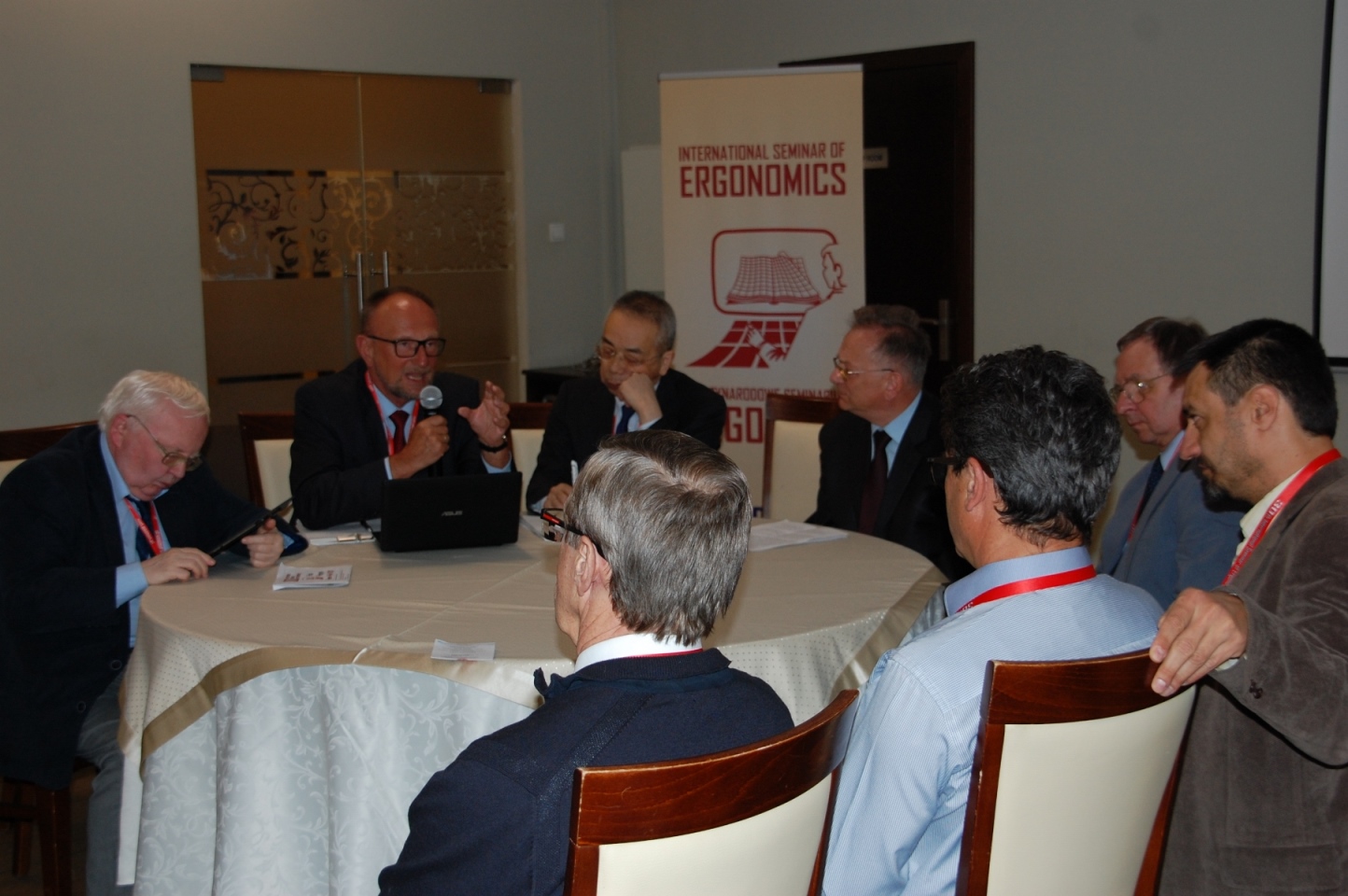
LEBThe Jubilee – 30th International Seminar of Ergonomics was held in Tarnow (Poland) from 9th to 11th May 2017. The Seminar was organized by:

  • Polish Ergonomics Society, Poznan Branch and Tarnow Branch
  • Poznan University of Technology, Faculty of Engineering Management
  • Malopolska Higher School of Economics
  • Polish Academy of Sciences, Poznan Branch, Committee on Ergonomics

FFES LogoThis conference was endorsed by the Federation of the European Ergonomics Societies

The 30th Seminar referred to the problems which were mentioned in the previous meetings, but this year the common theme was “Ergonomics and safety in lifelong human activity”. This approach concerns diverse issues of ergonomics and safety, not limited to professional activity. It shows an interdisciplinary character of contemporary issues in science which require simultaneous actions in diverse directions to create a synergistic effect that will help to solve the undertaken issues, both theoretical and practical.

Some data about seminar:

  • more than 110 participants,
  • 13 countries – from Bulgaria, France, Germany, Great Britain, Hungary, Japan, Netherlands, Poland, Portugal, Slovakia, Slovenia, Sri Lanka, Turkey
  • 4 keynote speakers in plenary sessions,
  • over 50 presenters in 8 section sessions and poster session,
    workshops,
  • a round table: International Ergonomics Association (IEA), Federation of the European Ergonomics Societies (FEES), Centre of Registration of European Ergonomist (CREE) and Polish Ergonomics Society.

Photo of a FEES event
From left: Prof. J. Olszewski, Prof. T. Juliszewski, Yushi Fujita (IEA),, Prof. L.Kozioł, Prof. M. Złowodzki, Dr. Szabó Gyula Eur. Erg. (FEES), Prof. Bernard Dugué Eur. Erg. (CREE), Prof. Pacholski Leszek M. Eur. Erg.

For more information visit www.iset.poznan.pl.

Workers and creativity 2017

FFES Logo Conference on “Workers and creativity: How to improve working conditions by participative methods?” organized by the Federation of European Ergonomists Societies, European Trade Union Institute (ETUI) and Belgian Ergonomics Society (BES) will be held in Brussels, on 26th and 27th of June 2017.

FFES Logo Conference on “Workers and creativity: How to improve working conditions by participative methods?” organized by the Federation of European Ergonomists Societies, European Trade Union Institute (ETUI) and Belgian Ergonomics Society (BES) will be held in Brussels, on 26th and 27th of June 2017.

ETUI jobs

The conference focuses on the issues of creativity related to the improvement of the working conditions by workers and worker representatives participation. The conference aims:

  • To promote ergonomics and ergonomists at European and national scale,
  • To develop relationships between European and National ergonomics level,
  • To extend relationships between EU bodies and FEES.

Lectures will be made by Ergonomists from National Societies, Trade Unionist from different countries and also from representatives of EU bodies.

The conference will be in English and French languages.

Registration of the participants is free of charge. Due to the limited numbers of seats, FEES member societies are invited to send the names of their representatives to the conference, as soon as possible. The link to reach the registration form is : https://goo.gl/forms/ufi1x3nRBbN63CDB2